









The great debate: vaginal examinations skills study sheet
Study sheet aim and key information:
Respectful vaginal examinations are an essential skill required of midwives. However, midwives also need to discern the necessity of vaginal examinations as ‘routine’ procedures against a preordained ‘clock’. Discerning necessary and unnecessary vaginal examinations is a skill in itself; this study sheet expands that idea to consider the other ways and methods of assessing the progress of labour without recourse to routine vaginal examinations. Therefore, facilitating a wider, more holistic approach to clinical care.
 Learning objectives:
- To identify the key clinical reasons for carrying out a vaginal examination.
- To critically evaluate the standardised approach to carrying out vaginal examinations.
- To critically evaluate the partogram.
- To identify the other methods of assessing labour progress.
Duration: 30 mins
Keywords: midwifery, vaginal examinations, clinical care


The Great Debate; vaginal examinations
Mhairi McLellan – 3rd year student midwife, Robert Gordon University, Aberdeen and co-editor of The Student Midwife journal
In our October edition of The Student Midwife journal we featured a Skills Spotlight article on how to perform a vaginal examination (VE). The article focussed mainly on the skill itself, while this blog aims to look at the larger discussion around the use of VEs as a clinical tool, particularly when used routinely during normal labour.
In UK hospitals it is fairly common for women/birthing people in active labour to be offered four-hourly VEs in order to assess progress. This is often done as part of a range of observations including counting and measuring contractions over ten minutes at regular intervals, with findings usually charted on a partogram (also called a partograph). This is standard practice in most units for all women regardless of risk categorisation and whether labour is spontaneous or not. However, there is some debate about the appropriateness of routine VEs for low risk women in spontaneous, uncomplicated labour which this blog will explore.
When do we perform VEs?
Regarding the use of routine VEs, it is reasonable to suspect that many hospital policies are based, at least in part on National Institute for Health and Care Excellence (NICE) guidance and therefore potentially affect many women regardless of individual circumstances.
NICE guidance (2017) suggests a VE can be useful as part of an initial assessment of labour onset, but also points out that this is not always necessary. They recommend women be offered VEs in established or active first stage of labour, which they characterise as from 4cm dilatation:
- on a routine four-hourly basis;
- if labour does not appear to be progressing well;
- for the reason of maternal request;
They define delay in the first stage of labour as progress of less than 1cm dilatation between two VEs, two hours apart, and goes on to detail recommended interventions following confirmed delay including artificial rupture of membranes (ARM), a further VE after 2 hours, transfer to consultant-led care and to consider augmentation with oxytocin (NICE 2017).
Newer research by Oladapo et al (2018) suggests the active phase of the first stage of labour, characterised by accelerating dilatation of the cervix, may not start until the dilation reaches 5–6 cm. Slow progression before 6 cm of dilation may not, therefore, represent prolonged or delayed labour. Are we too quick to diagnose a delay?
Why do we use VEs to measure progress; important considerations?
 Dahlen et al. (2013) state that the use of cervical dilatation as way to measure labour progress – and using the time defined partogram originated from the work of Emanuel Friedman. However, cervical dilatation was only chosen as the way to measure progress because it was the easiest to quantify in numerical terms, not because it is the most accurate (Dahlen et al. 2013). Moreover, the quality of the data that led to Friedman’s conclusions around acceptable rate of dilatation and labour progress are of questionable quality due to issues in the research sampling methods and sample size (McDonald 2010). Based on Friedman’s work, set time limits within which women need to have made sufficient progress from the last VE to avoid being diagnosed with delay and setting off a cascade of interventions, as recommended in the NICE guidelines (2017), have been created.
Zhang and Duan’s (2017) newer work propose that future research should make efforts to further understand the physiologic pattern of labour in order to make the first steps toward optimal labour management. In addition, cervical dilation is only one of the parameters measuring labour progression.
“A multi-dimensional approach may be needed to provide better accuracy in identifying a woman in true labour protraction and arrest” (p1)
Issues with routine VEs in uncomplicated labour
By trying to make all women fit into specific, arbitrary time frames and expectation of linear progress of at least 0.5cm dilatation an hour we could be, arguably, medicalising and mechanicalising childbirth, crucially moving away from the idea that childbirth is a normal, physiological event in a woman’s life (McDonald 2010; Dahlen et al. 2013). McDonald (2010) further suggests variations in normal labour progress may also depend on a woman’s ethnicity.
By using regular VE intervention we are no doubt, at times, compromising the complex hormonal actions that promote normal labour progress. The action of cortisol blocking natural oxytocin production and therefore quantity and quality of contractions every time we interfere.
In addition, four-hourly VEs contribute to the conveyer belt/assembly line culture within hospitals rather than placing each individual at the heart of care.
In assuming all labours will be homogenous and fit into a neat box, lest they be classified as abnormal and warrant intervention, are we perhaps losing our ability to support normality by eroding our other ways of knowing, as well as creating a self-fulfilling prophecy of delay, intervention and reclassification of women as high risk (Scamell and Stewart 2014). Diagnosis of delay or ‘failure to progress’ is all too common. That’s without going into the loaded nature of the terminology!
A study looking at midwives’ experiences of standardised maternity care based on broad policies and guidelines found that midwives reported adherence to strict timeframes and vigilant surveillance of birth progress to be at odds with their philosophy of birth as a normal, physiological life event (Scamell and Stewart 2014). Many midwives in this study noted the pressure to work in this way, either feeling duty bound by their contract of employment or pressure to be part of the system in which they practice (Scamell and Stewart 2014).
A further issue with strict adherence to routine VEs and intervening based on findings is that VEs can be very unreliable with frequent differences in findings when the same VE is performed by different practitioners (Dahlen et al. 2013). Additionally, the process of VEs can be painful and uncomfortable for some women and the occurrence of increased pain with contractions following VE have been noted, potentially due to prostaglandin release while the cervix is being stimulated (Dahlen et al. 2013).
The partogram
The partogram itself is a contentious issue; there does appear to be some benefits in terms of it being easy to use, providing an at a glance overview of information, such as cervical dilatation, fetal heart rate, maternal pulse, maternal blood pressure and maternal temperature in order to identify protracted labour. However the evidence for its accuracy is weak (McDonald 2010). Conversely, Bedwell et al. (2017) suggest the partogram is not, in fact, an easy to use tool, highlighting variations in accuracy between practitioners, as well as a lack of training about how it should be completed.
In their Cochrane review looking at the effects of partogram use and effects of different designs of partogram, Lavender, Cuthbert and Smythe (2018 p. 4) concluded that:
“we cannot be certain of the effects of routine use of the partograph as part of standard labour care, or of the different partograph designs. Further trial evidence is required to establish the efficacy of partograph use per se and its optimum design.”
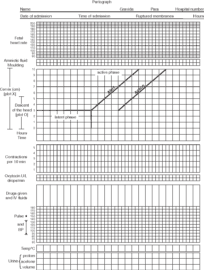 The timing of when to start the partogram is also very important. Women who are admitted to hospital in the latent phase of labour could have time frames imposed on their labour if the partogram is commenced too soon. The longer women are in hospital the more likely they are to have interventions such as augmentation with oxytocin, ARM and ultimately an assisted or caesarean birth (McDonald 2010).This not only has potential consequences for the woman, but newer research indicates links of caesarean birth with childhood disorders such as asthma, obesity and neurodevelopment delay (Zhang and Duan, 2017).
The purpose of this blog has not been to suggest that all VEs are unnecessary, or that using a partogram is a waste of time. There are many situations where a VE will add important information to the overall clinical picture and will aid in decision making. There are good reasons for identifying prolonged or obstructed labours and, in some cases, intervening to avoid associated morbidity, such as the risk of postpartum haemorrhage, obstetric fistula and fetal hypoxia (Schuiling 2012).
It is however important to be aware of the lack of robust evidence to support routine VE and use of a partogram in uncomplicated, spontaneous labour and the impact over-interference may have on birth. Midwifery skills considering all holistic aspects, considering necessity, timing and value of a VE, particularly when offering a VE and gaining consent is paramount.
Other ways of midwifery knowing/assessing progress
There are a number of alternatives to VEs in order to assess progress and even when VEs are being performed these should be considered as part of the clinical picture:
- Women’s behaviour, body language and tone of voice.
- Increase in length and strength of contractions as reported by the woman and/or felt on abdominal palpation. Towards second stage contractions may become less frequent.
- Purple line in the anal cleft that progresses as labour progresses.
- Rhomboid of Michaelis, where the fetal head is thought to put pressure on the sacrum and coccyx which can be visible as a dome shape on the woman’s back.
- Increased blood-streaked mucoid show visible at the introitus.
- Gaping or pouting of anus and pouting of vulva may occur during or as second stage approaches.
(Adapted from Downe and Marshall 2014).
Reference List
Bedwell et al. (2017). ‘A realist review of the partograph: when and how does it work for labour monitoring?’ BMC Pregnancy and Childbirth, 17(1).
Dahlen, H. et al. (2013). ‘Vaginal examination during normal labor: routine examination or routine intervention?’ International Journal of Childbirth, 3(3), pp. 142-152.
Downe, S. and Marshall, J.E. (2014). ‘Physiology and care during the transition and second stage phases of labour.’ In: J. Marshall and M. Raynor (eds). Myles textbook for midwives,16thed. Edinburgh: Elsevier. pp. 367-394.
Lavender, T., Cuthbert, A. and Smyth, R.M.D. (2018). ‘Effect of partograph use on outcomes for women in spontaneous labour at term and their babies.’ Cochrane Database of Systematic Reviews, 2018(8).
McDonald, G. (2010). ‘Diagnosing the latent phase of labour: use of the partogram.’ British Journal of Midwifery, 18(10),pp. 630-637.
National Institute for Heath and Care Excellence (NICE) (2017). Intrapartum care for healthy women and babies. London: NICE.
Oladapo, O. et al. (2017). ‘Cervical dilatation patterns of ‘low-risk’ women with spontaneous labour and normal perinatal outcomes: a systematic review.’ BJOG: An International Journal of Obstetrics & Gynaecology, 125(8), pp. 944-954.
Scamell, M. and Stewart, M. (2014). ‘Time, risk and midwife practice: the vaginal examination’. Health, Risk and Society, 16(1), pp. 84-100.
Schuiling, K.D. (2012). ‘The need for research on the use of the partogramand its effects on maternal infant outcomes.’ International Journal of Childbirth, 2(1), pp. 3-4.
World Health Organization (WHO) (2018). WHO recommendations: intrapartum care for a positive childbirth experience.Geneva: WHO.
Zhang, J. and Duan, T. (2017). ‘The physiologic pattern of normal labour progression.’ BJOG: An International Journal of Obstetrics & Gynaecology, 125(8), pp. 955-955.
FURTHER READING, VIDEOS AND LINKS

The download button below enables you to be able to print off and complete the study sheet, alternatively you might want to annotate the PDF and save to your computer, ready for adding to your student portfolio or for midwifery revalidation
-
Extend your learning by looking through the further reading, videos and links above and completing the practise challenges within the article
- What are the usual reasons for carrying out vaginal examinations? (list them).
- Identify 3 key arguments against routine vaginal examinations.
- Discuss the current evidence regarding the partograms, when might they be useful? But what the potential issues?
- List all other methods of assessing labour progression and consider a time in practice when you have seen this in action.
- Reflect on your own practice, what might you learn from this study sheet that could enhance your midwifery skill-set? Critically appraise your current skills, what are you already good at? What do you need to develop? Then create an action plan of how you can develop those skills.
