Ask a Midwife: Advice and Perspectives from a Specialist Cultural Liaison Midwife
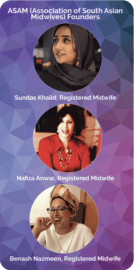
Benash Nazmeen – Specialist Cultural Liaison Midwife, Bolton NHS Foundation Trust
Published in The Student Midwife Volume 3 Issue 4 October 2020
Summary
Specialist cultural liaison midwife and Association of South Asian Midwives (ASAM) co-founder, Benash Nazmeen RM, answers questions from students, midwives and the TSM editorial board. We focus on her decision to pursue a career in midwifery, her student midwife journey and the work she is doing to elevate the voices of women from marginalised communities and support of pre-registration and qualified midwives to develop culturally safe practice.
Q1 What made you consider midwifery as a career and what support or advice did you receive when applying for a place at university?
Fay, second-year student midwife
BN Would you believe it if I said I flipped a coin?
I knew I wanted to go to university; however, I wasn’t sure what I wanted to do. The week before the UCAS deadline was due, I read at least five prospectuses front to back. Both teaching and midwifery caught my eye. Unable to decide between the two, I flipped a coin! Funnily enough, following my successful application, I told my mother and she informed me that my grandma was the village midwife and said: ‘It’s in your blood.’ I’m a firm believer in fate; midwifery was always meant to be my future. What I didn’t realise was what a significant role it played in my past. My connection to my grandmother may not have come to light then, because it’s not routine to discuss such topics with your unmarried daughter within my first-generation immigrant family.
Q2 Did you ever consider your race/colour as a barrier to your progress during your midwifery training and after qualification?
Kimberley, third-year student midwife
BN My race and colour are my strength and secret weapon; they break down barriers when I care for birthing people/women of a similar race, ethnicity, religion and colour, or who have faced bias or discrimination. As a midwife, I like to make my intention clear at the very beginning – to care with ‘all that I am’. I have been known to say ‘I am all yours’ to those in my care, because I am, wholeheartedly, dedicated to them for that shift.
Q3 As a non-white midwife, have you ever felt unsupported or ‘punished/disciplined’ for speaking up against something? If so, how did you handle it?
Fatima, first-year student midwife
BN I once felt I was punished for asking for help, speaking out of turn and maybe for not having the right connections or possibly the ‘right’ skin tone. Being South Asian, I navigate an added insecurity around race when I’m left feeling rejected or dejected. That occasion may not have had anything to do with the lack of guidance and support I got, but that doesn’t mean the thought did not occur to me.
Q4 What piece of advice would give Black and Asian student midwives that you wished someone had given you?
Chelsea, first-year student midwife
BN The only advice I got was from my psychology teacher, who suggested I should apply for medicine over midwifery. I am glad I didn’t listen to him. The advice I would give to anyone starting their journey is that the uncertainty, the underrepresentation, the fear of rejection, is not yours alone. Black, Asian and midwives from other marginalised backgrounds share these feelings with you. You are represented in the workforce. You may not be able to see it in your local hospital, but you are not alone. We are here for you; we stand by you and we will support and mentor you.
Q5 Have you ever felt like you were recruited as a student or registered midwife as a tokenistic gesture?
Sephora, first-year student midwife
BN I was told by my awesome kickass tutor that she fought tooth and nail for my place at university after witnessing my interview for the course, because I was disadvantaged by my estimated grades (a topic for another time is the systemic institutional racism within education whereby teachers under-predict grades for Black and Brown pupils). Since then I have worked hard in my own time, using my own resources to keep learning and developing. Whenever someone questions my recruitment as a registered midwife, they soon back down when I start spouting statistics, research and evidence.
Q6 Should the promotion of diversity and inclusion be the responsibility of students or midwifery staff?
Karen-Grace, second-year student midwife
BN </
span>Diversity and inclusion are terms that have always left me confused; they are often used to discuss equity and equality. ‘Diversity’ highlights differences, and ‘inclusion’ expresses the need to balance the scales, to ensure individual differences are valued. It is like saying ‘you are not included because you are different, and we need to fix this’. In all actuality, the ability to adapt is something some communities have needed to develop as a prerequisite to survive the move to a foreign country. However, our systems are not always willing to adapt or accommodate, and assimilation is one sided. Where is the equity and balance in this?
As students and midwives, we need to co-create our practice with women to develop culturally safe and responsive practice. As professionals and trainees, we need to take responsibility for being culturally competent, by looking out for relevant training, modules and literature, or attending workshops such as those developed by the Sheffield Maternity Cooperative and MyMidwives UK. To balance the scales and improve the pregnancy outcomes of Black and Asian women, it takes work from both sides. This is what we should be trying to build towards. This should be everybody’s responsibility.
Q7 As a student midwife training in the UK, can you suggest any strategies to help me to address my unconscious bias?
Sarah, registered midwife
BN Unconscious bias is difficult to unpick. How can you address something you are unaware you possess? That is the dilemma; only a person with a different lived experience and insight can truly show another the privilege and bias they have. But this is not their job. Asking someone to do this work for you is also a form of bias. Some questions you can ask yourself to begin recognising and addressing unconscious bias are:
- Is your social group diverse? Why/why not?
- When was the last time you started a conversation with someone that looked outwardly different to you?
- When was the last time you made an assumption about someone’s religion based on their name?
- Have you ever made the effort to correctly pronounce a name that sounds different or foreign?
- When you answered the last question, did a certain type of person come to mind?
- If you have you ever been involved in or overheard conversations that expressed racial bias towards a particular group or community, for example group A always delay consenting to postdate inductions, or group B have low pain thresholds, did you question these opinions or let them slide? How are you going to act differently in the future?
Q8 As student midwives, how can our readers develop confidence and skills outside of university?
TSM editorial board
BN Here’s an important lesson: don’t solely rely on others to support your development. I took that responsibility. I attended every conference I could in my own time, invested in myself and took every learning opportunity.
It was lonely, because I was often the only person of colour present at conferences or events, but I was gaining experience, understanding and confidence. I gained my own job satisfaction and used the knowledge I gained to support and advocate for those in my care. Students and qualified midwives alike can apply for the Iolanthe Midwifery Trust awards listed here as useful resources, to fund training and self-development and research.
Q9 Why did you found the Association of South Asian Midwives (ASAM)?
TSM editorial board
BN It was meant to be a simple platform to raise awareness and understanding within the maternity care sector about issues that affect South Asian communities. We launched an Instagram account and have been overwhelmed by the support and messages we have received. Watch this space as we have more exciting things coming your way soon!
Q10 Can you tell us more about your specialist cultural liaison midwife role?
TSM editorial board
BN The job is a dream role that is constantly evolving. I have been working hard to better understand the demographic and pregnancy outcomes of my locality before we start to make changes. This is something I am so passionate about. I cannot stop thinking about how we have a real chance to make maternity services responsive to needs of the diverse communities it serves.
Q11 Why did you start the Community of Cultures Maternity Forum?
TSM editorial board
BN The goal is to develop understanding and awareness of cultural factors, and how women perceive their care providers and the care they receive. If you follow me on Twitter, watch out for posters for upcoming sessions or sign up for updates via Eventbrite. Places are limited and allocated on a first-come, first-served basis, so I can provide a balance of individuals and healthcare professionals. TSM
| List of Useful Resources for students and qualified midwives |
- A Community of Cultures Maternity Forum
- Iolanthe Midwifery Trust Awards
- Dora Opoku Student Award
- Jean Davies Award
- Mary Cronk Award
|
| Social Media Resources to follow |
| @ASAMidwives (Instagram)
@NNCAUK Nigerian Nurses and Midwives Charitable Association, UK (Twitter)
@mymidwivesuk (Instagram)
@pinkladoo (Instagram) |