








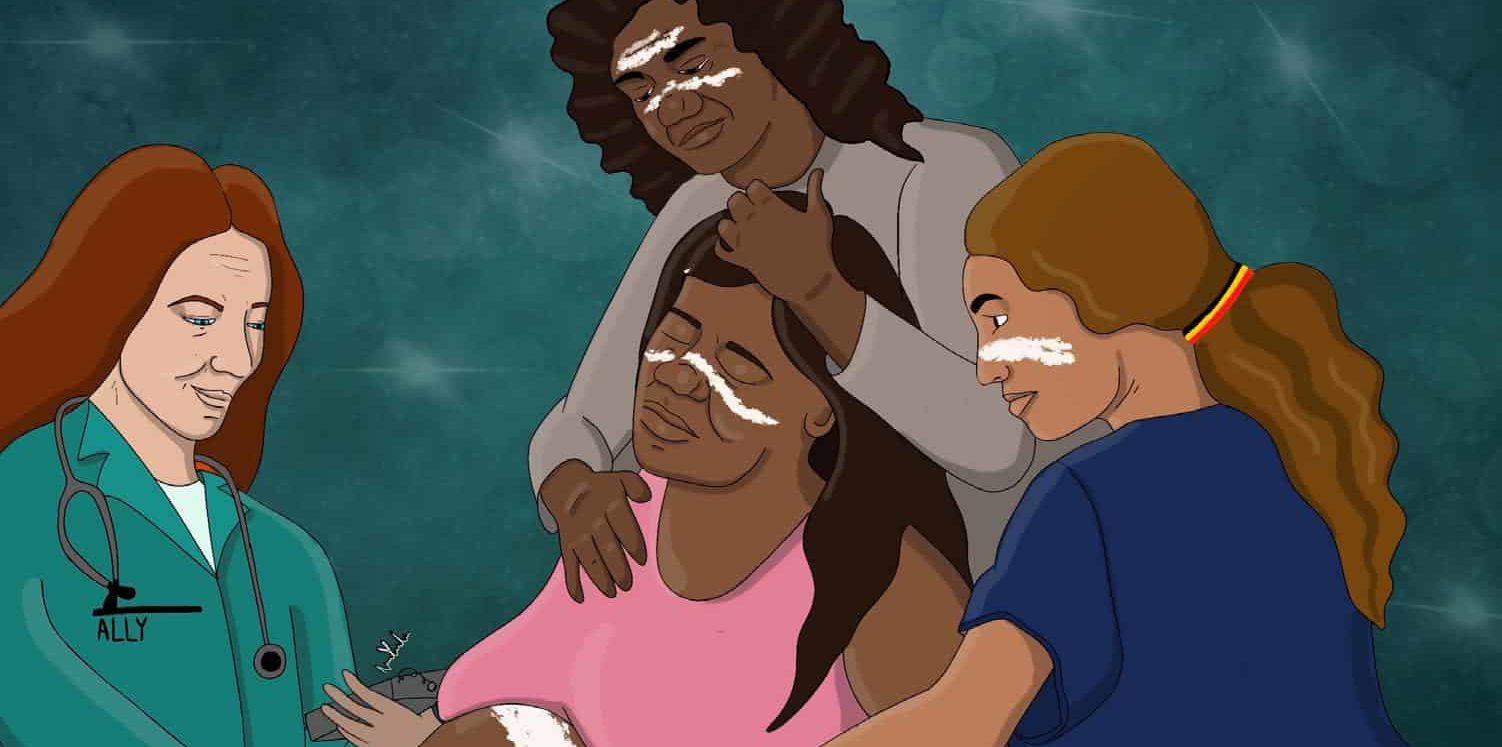
Cultural Safety in Midwifery 1. Cultural Safety in Midwifery for First Nations Women, People and Families
Renae Coleman – Associate Lecturer of Midwifery at Western Sydney University, New South Wales, Australia; Co-Editor-in-Chief, The Practising Midwife Australia; Registered Midwife
Twitter @Renae_C_Midwife
Alison Barnes – Associate Lecturer of Midwifery at Western Sydney University, New South Wales, Australia
Published in The Practising Midwife Australia Volume 01 Issue 01 September 2022, Pages 14-17
https://doi.org/10.55975/YUTL5712
Summary
This is the first series of Midwifery Basics. It will contain a collection of authors, curated by Renae Coleman, and will explore the concepts of ‘cultural safety in midwifery’ within the Australian context. This series will consider the importance of equity, diversity, and inclusion, and show how midwives and birth workers are essential in creating a safe space for all.
Introduction
In this first article of the series, Renae Coleman and Alison Barnes will consider the importance of cultural safety for First Nations women, people and families. Renae is a Boorooberongal woman from the Darug Nation, fortunate to be living on Country. She is a registered midwife and currently working at Western Sydney University as an Associate Lecturer of Midwifery.
Part of Renae’s role is supporting First Nations students in the School of Nursing and Midwifery to not only complete their studies but enjoy their time at university by creating a culturally-safe experience. Alison Barnes is a proud Wiradjuri woman and a registered nurse with over 30 years professional experience across primary health, mental health and critical care. Alison has also worked for Link-Up NSW.
She is a mother, artist and poet. Alison is an Associate Lecturer in the School of Nursing and Midwifery at Western Sydney University and is involved in helping to embed contemporary Aboriginal culture across the curriculum. She has a lifelong commitment to improving the health and wellbeing of Aboriginal and Torres Strait Islander peoples.
Acknowledgement of language
With great respect and acknowledgement of the diversity within Aboriginal and Torres Strait Islander Nations and peoples, this paper will respectfully use the term First Nations people.
Cultural safety defined
The term “cultural safety” was first introduced by Maori midwifery students in the 1980s, in response to feeling unsafe in the Anglo educational setting, which led to the development of cultural safety principles to redress Indigenous health inequities in New Zealand.1 Cultural safety is about creating an environment and developing relationships that are safe for First Nations people.
Importantly, the achievement of cultural safety can only be determined by the person receiving the care. Practice becomes unsafe when an individual’s cultural identity or wellbeing is affected by means of demeaning, disempowering or diminishing the individual.2 The National peak body, the Congress of Aboriginal and Torres Strait Islander Nurses and Midwives (CATSINaM) have made considerable progress in championing the cultural-safety movement in the nursing and midwifery context.
With close consultation with CATSINaM, the Nursing and Midwifery Board of Australia (NMBA), updated the Code of Conduct for Midwives which now includes a discrete section pertaining to First Nations peoples’ health, and culturally safe and respectful practice.3
Practice reflection point:
Since the introduction of the new Code of Conduct for Midwives in 2018, how do you ensure you are meeting your professional obligation to provide culturally safe and respectful care to First Nations women, people and families?
There has been a move away from cultural competence in the health setting. Cultural competence is presented in a way that has a start and an endpoint, assuming once you are deemed culturally competent there is nothing more to learn. Cultural humility on the other hand is a life-long journey, where committed midwives can meet their professional obligations in caring for First Nations women, people and families.
Cultural humility involves respectful inquiry and empathy as midwives learn to be open to other people’s cultural ways of being, knowing and doing.4 Midwives devoted to the mindset of cultural humility are best positioned to provide culturally-safe care, as committed life-long learners.
The Australian Nursing and Midwifery Accreditation Council are the responsible body for accrediting Australian nursing and midwifery programs of study. The Midwife Accreditation Standards 2021 require programs to include a mandatory
Practice reflection point:
What learning have you engaged in, to strengthen your own culturally-safe practice? How many hours of your continued professional development learning do you allocate to ensure your practice is culturally safe? Do you think there should be a minimum set number of hours dedicated to this?
Defining key terms and language
It is essential that midwives, alongside all who provide maternity and perinatal services, have knowledge of the key terms and language used to describe individuals, communities and societies in their care. Labels and phrases such as race, culture, ethnicity, systemic racism, equity, and cultural humility should be carefully and critically considered.
You can review a range of these terms and phrases at All4Maternity, via the online version of this article. Head to the article archive, in the Sharing space to access this Basics article for further learning. As you review these terms, critically reflect on your perspectives and how these words and their use impact on maternity experiences and care.
Why cultural safety matters
Cultural safety matters to First Nations peoples as it means we are able to access the care we need, confident that we will not be subjected to further harm. In a 2014 survey in Victoria, First Nations adults were found to be seven times more likely to have experienced racism than non-indigenous Australians.6 It is acknowledged that First Nations people experience a range of inequalities and disparities in accessing health care across Australia.
Nolan-Isles, Macniven7 identified six themes which were considered both barriers and enablers as access to healthcare for First Nations people. Trust in the health service and experiences of cultural safety was one of these six themes.
Barriers and Enablers to Health Care: Six Themes
- Improved coordination of healthcare services.
- Better communication between healthcare services and patients.
- Trust in the service provider and experience of cultural safety.
- Importance of prioritising health services towards key personal and community issues as defined by Aboriginal people.
- Importance of reliable, affordable and sustainable healthcare services.
- Distance and transport availability impact access to health care services.
Fear is a driver of both when and how Indigenous people access health care. It is not just a fear of racism it is also a fear of attracting the attention of government agencies and thus their involvement in the lives of First Nations peoples.7 Culturally-safe maternity provisions can reduce that fear and encourage First Nations people to access health care before health issues reach a critical stage.8
This includes when and how frequently First Nations women access midwifery care.7 Fear of government intervention in their lives is a reasonable response to the harms caused by both past government policies and the alarming rate at which First Nations children continue to be removed from their families.9
During research for this paper several studies were reviewed where comments were included about non-Indigenous midwives and their attitudes to First Nations women. In particular the work by Thackrah, Wood10 included a number of quotes in which early career or student midwives recounted stories about behaviour which could only be considered disturbing or simply racist, but all offered an excuse for the midwives behaviour. I do that myself. But when does it become simply unacceptable and when can we stop making excuses for our colleagues?
Practice reflection point:
Take time to think about personal experiences, have you experienced or witnessed racism?
How do we change this?
The current trend is to talk about decolonising midwifery. Decolonising midwifery in Australia must first begin with truth telling.11 We must have truth to build a foundation of trust with First Nations women. This is a difficult thing for us to do as midwives because we need to acknowledge our profession’s role in the past caused harm to First Nations people.12 This will enable us to reflect on our profession’s current role in ongoing harms to First Nations peoples such as the continued removal of our children.
Once we have acknowledged history and reflected on our current roles, we will be able to move forward with the work required to instil true equity, fairness and inclusivity within the midwifery profession. This will require us as a broader profession to ensure we can move into the future with a diverse, inclusive and culturally-safe workforce. TPM
Practice reflection point:
Have you ever taken handover and a colleague has said ‘the Aboriginal woman’, or ‘the Muslim woman’, or ‘the African woman’? How do you speak out against racial profiling?
References
- Australian Human Rights Commission, Cultural safety for Aboriginal and Torres Strait Islander children and young people: A background paper to inform work on child safe organisations. Child Safe Organisation. Published 2018;1-13.
- National Aboriginal and Torres Strait Islander Health Workers Association: cultural safety framework Summary. https://www.natsihwa.org.au/sites/default/files/natsihwa-cultural_safety-framework_summary.pdf. Published 2016.
- Nursing and Midwifery Board of Australia. Code of conduct for midwives. http://www.nursingmidwiferyboard.gov.au/Codes-Guidelines-Statements/Professional-standards.aspx. Published March 01, 2018.
- Hughes V, Delva S, Nkimbeng M, et al. Not missing the opportunity: Strategies to promote cultural humility among future nursing faculty. Journal of Professional Nursing. 2020;36(1):28-33.
- Australian Nursing and Midwifery Accreditation Council. Midwife accreditation standards 2021. https://anmac.org.au/sites/default/files/documents/06920_anmac_midwife_std_2021_online_05_fa.pdf. Published January 29, 2021. Accessed January 17, 2022.
- Markwick A, Ansari Z, Clinch D, McNeil J. Experiences of racism among Aboriginal and Torres Strait Islander adults living in the Australian state of Victoria: a cross-sectional population-based study. BMC Public Health. 2019;19(1):309.
- Nolan-Isles D, Macniven R, Hunter K, et al. Enablers and Barriers to Accessing Healthcare Services for Aboriginal People in New South Wales, Australia. International Journal of Environmental Research and Public Health. 2021;18(6).
- Kairuz CA, Casanelia LM, Bennett-Brook K, Coombes J, Yadav UN. Impact of racism and discrimination on physical and mental health among Aboriginal and Torres Strait islander peoples living in Australia: a systematic scoping review. BMC Public Health. 2021;21(1):1302.
- O’Donnell M, Taplin S, Marriott R, Lima F, Stanley FJ. Infant removals: The need to address the over-representation of Aboriginal infants and community concerns of another ‘stolen generation’. Child Abuse Negl. 2019;90:88-98.
- Thackrah RD, Wood J, Thompson SC. Cultural respect in midwifery service provision for Aboriginal women: longitudinal follow-up reveals the enduring legacy of targeted program initiatives. International Journal for Equity in Health. 2020;19(1):210.
- Power T, Geia L, Adams K, et al. Beyond 2020: Addressing racism through transformative Indigenous health and cultural safety education. Journal of clinical nursing. 2021;30(7-8):32-35.
- Raeburn T, James M, Saunders P, Doyle AK. The importance of local history for nurses: An Aboriginal Australian microhistory. Collegian. 2020;27(6):613-619.

