








Connections and Care: Newborn Life Transitions
Dr Anna Coonan-Byrom – Midwife, Educator, Researcher, CEO and Founding Director All4Maternity
Twitter @ACBMidwife
Published in The Practising Midwife Australia Volume 01 Issue 01 September 2022, Page 19
https://doi.org/10.55975/GHNB3308
Introduction
Newborn consciousness
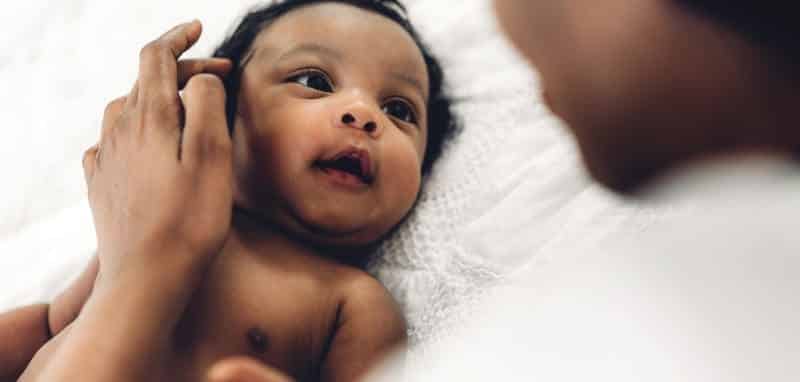
Consciousness can be described as a ‘sensory awareness of the body, the self, and the world’.3 At birth, the newborn’s brain is in a transitional stage but is far from empty or inactive.4 In terms of consciousness, whilst babies may have limited awareness of their body, self and world they are born expecting to hear the heart, sound and scent of their mother or parent. Facilitating immediate and ongoing newborn-mother/parent connection is crucial for enabling optimal transition to life.
Newborn connections
Shonkoff and Garner have described an ‘ecobiodevelopmental model’ to ensure early neonatal care supports life-long health trajectories.5 This model proposes that ecology becomes biology and together they drive development across the life span. The process of human development is understood as a result of ‘nature dancing with nurture over time’.5 You can see the features of the model, informing neonatal and paediatric care in Figure 1.
Figure 1 – Fundamentals of neonatal and paediatric science adapted from Shonkoff and Garner5
<div.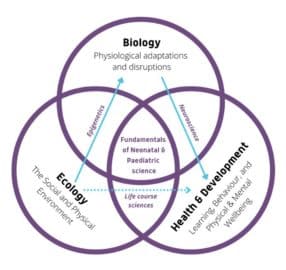
Nils Bergman argues that what the baby needs most at birth is the mother or birthing parent.1 The mother or parents’ body offers vironmental (eco) and biological (bio) developmental support to the newborn. As such it is crucial to place the baby in skin-to-skin on the birthing mother or parent’s bare chest, ensuring both are covered for warmth. From this position, the newborn develop consciousness: their awareness of themselves and the world around them.
Newborn care
Beyond birth, ongoing close contact, touch, breastfeeding, positive interactions and communication help to support effective neuro-development, strengthening social development. Midwives, doctors and those caring for newborns should adjust their routine practices ensuring dim lighting, quiet, responsive and personalised care for the infant-mother/parent dyad, respecting harmonious, natural adaptations and transitions. Newborn care based on the ecobiodevelopmental model will ensure the holistic needs of the baby and family are met. TPM
You are nature – Weleda wisdom
In 1921, Weleda founders Rudolf Steiner, Ita Wegman and Oskar Schmiedel pioneered a vision for a better future. From the beginning Weleda has centred people, society and nature, setting standards for sustainable, certified natural skincare and anthroposophic medicines based on their understanding of the inseparable connections between human beings and nature.
Calendula is one of the plants that Weleda use to develop natural products to offer protection for delicate, irritated or injured skin. Beyond the newborn period and early days and weeks of life, care should be taken to use treatments and products, as necessary, that are natural and sustainable.
For more information visit www.weleda.com.au
References
- Bergman J, Bergman N. Whose Choice? Advocating Birthing Practices According to Baby’s Biological Needs. J Perinat Educ. 2013;22(1):8-13. doi:10.1891/1058-1243.22.1.8.
- Hillman N, Kallaur S, Jobe A. Physiology of Transition from intrauterine to extrauterine life. Clinic Perinatol. 2012;39(4):769-783. doi:10.1016/j.clp.2012.09.009.
- Lagercrantz H, Changeux JP. The Emergence of Human Consciousness: From Fetal to Neonatal Life. Pediatr Res. 2009;65:255-260. doi.org/10.1203/PDR.0b013e3181973b0d.
- Fransson P, Skiold B, Horsch S, et al. Resting-state networks in the infant brain. Proc Nat Acad Sci U S A. 2007;104:15531–15536. doi:10.1073/pnas.0704380104.
- Shonkoff J, Garner A. Technical Report: The lifelong effects of early childhood adversity and toxic stress. Pediatrics. 2012;129(1):e232-46. doi:10.1542/peds.2011-2663. Accessed August 11, 2022.

