









Transition to a New Electronic System of Documentation
Elizabeth Lephard – Midwife, Bradford Royal Infirmary
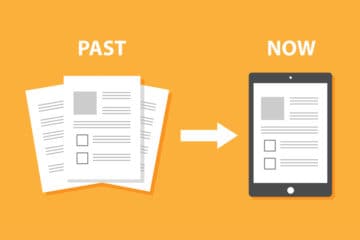
 The service in which I work has just made the transition to a new electronic system of documentation… a daunting prospect for a midwife on a busy Labour Ward. However as the date for going live sped nearer I had to engage with the reality that, like many midwives in the 2020s, I would soon no longer really need my pen. This is an account of how the transition has been for me, in my workplace, in this little corner of the UK.
For me the story starts aged five, in 1984. I proudly posed for the local newspaper with my friend in front of the brand-new computer at school; the story being that we had one, right there, in our classroom. Much later, in 1995, I remember accessing the internet for the first time. And I was 21 when I first owned a mobile phone. Things have changed since then.
When I started my midwifery degree in 2015 I quickly discovered that in some parts of the NHS, things hadn’t actually changed all that much. Women/birthing people carried paper notes, with summaries of these notes filed in enormous folders. Forms were photocopied. I was astonished to find myself learning how to use a fax machine. The woman/birthing person’s electronic records (that other professionals could access) also needed updating, so every antenatal appointment involved triplicating information.
Once qualified, I found that my new unit used a digital/paper mix of documentation. Antenatal notes were online, intrapartum notes were on paper with a summary online, and postnatal documentation was online in hospital, and on paper in community. We accessed a separate system – which the hospital used for their documentation – for medications and results.
This was obviously ‘clunky’ and unsustainable, with time being spent duplicating information to ensure nothing was missed. However the prospect of change was challenging.
The change over
On Saturday morning we were documenting on paper as usual and by Saturday evening we were using a system that was almost completely new to us, while the women/birthing people continued to labour in an environment that would be as unpredictable as ever.
The new system in intrapartum has two parts: an electronic CTG recording and the labour documentation. The electronic CTG trace is actually really easy to use – you double-click on the screen to annotate it, which is doable even under pressure, when lots of things are happening at once. The documentation has required a switch from a reliance on long-hand summaries to inputting data into spreadsheet-style boxes.
We can – and do – write long-hand, however we have been told repeatedly that all of the information needs to be in the boxes – not just the numbers (fetal heart, maternal observations, fluid balance) but the assessments we might have felt better suited freehand text (vaginal examinations, reviews of the CTG).
It is challenging not to be able to clearly see a summary of the data we have inputted, to see where any gaps are. These are only slowly becoming evident as the information feeds back postnatally, or when the notes have been reviewed. It is very difficult to write less in the longhand summaries, and I haven’t yet talked to any midwives who want to.
I’ve realised my long-hand notes are for my own security and reference; to lay out what I know about the woman/birthing person and her care, what has already happened, what I am observing and my ongoing plan.
There is also an issue of only being logged into the system on one computer at a time. If we are inputting 15-minute observations in a labour room, it isn’t possible to look up the results in the office, for example, without suddenly being logged off in the labour room. This feels quite limiting when working with students, and was extremely confusing the one time I briefly looked after two women on CTGs. But we have been able to adapt, and I’m currently hyper-aware of ensuring nothing is missed.
Twelve weeks on, I can see that the system is saving us time, as well as a lot of paper, and so far the computers have proved surprisingly reliable.
The move to digital documentation is complex and challenging, but also essential. I was helped by the thought that I had learnt how to navigate social media, so I could learn this new system. We had some training, and I made copious notes. This is how it unfolded:
Three days to go
I’m isolating with COVID-19, but very aware of the nerve-wracking shifts approaching, and trying not to think about it. I tell myself that I’ve met challenges before and that plenty of people have met this particular challenge successfully. I know how important it is to be positive. This has to work well. I want to learn quickly, to be able to get on with my job. Transitions are normally uncomfortable, and I know there will be negativity but I work with a wonderful, capable group of people who adjust quickly to challenges. We will need some grace for ourselves and for each other and we will need to gather our courage.
One day to go
I feel nervous now – back in work tomorrow. I plan to re-read the notes I made and re-watch the training videos. I know that Labour Ward will not pause for me to leisurely learn the system and I want to be present with the people I care for, while quickly picking up the new system at the side of the room. I don’t know if I can do that.
I fear being distracted from the care.
I fear things happening quickly, taking notes on bits of paper, having a lot of work to do later.
I fear no longer being efficient.
Being out of my depth. Feeling at sea.
But we do this together; I’m part of a team. We have to meet this new challenge head-on. And we will have to find the extra time and the extra kindness that some of us will need.
Day 1 complete!
Bad dreams of malfunctioning computers didn’t leave me feeling refreshed this morning and now I am so tired. I’d forgotten how draining it is when everything is new. Everyone around me was totally focused, trying to learn as quickly as possible. The unit was flooded with yellow t-shirted ‘floorwalkers’ – problem-solvers – which helped.
Of course we learn a bit at a time.
The shift was not too busy and I had a plan, using my own cribsheet and reverting to paper notes if I needed to document properly later. I was surprised to find I was sometimes able to help my colleagues. I decided not to mention the transition to the woman I was caring for, not to take the focus away from her and her baby, and I think I managed to give her the care and attention she deserved. I was so afraid that I wouldn’t.
I actually feel quite privileged, to see a large group of people working together to make a huge transition successful. It is no small thing.
Day 2 complete
More dreams of malfunctioning computers. But in reality, it feels like this might just be okay. There are things I haven’t attempted yet on the system and things that don’t work. Some people are really struggling and some people have really carried the weight of the change. But there have been several comments that it’s not as bad as we thought it would be. It could actually save us time.
I find myself wondering if the paperwork after a birth might take ten minutes instead of 20. I wonder if it might be possible to give more care, not less. I wonder if I might really like it.
I feel for the community midwives, seeing women discharged with our patchy, beginner electronic records. I’m hugely grateful for the senior midwives, for their professionalism, their calm in this controlled storm. And I want to remember this experience of being daunted, of finding courage and of coming out the other side of this challenge. Because of course, there will be other challenges.
2 weeks in
The yellow t-shirts have gone. I use my little cribsheet often, pouring over my own careful instructions to myself. But I realise that quite a lot is becoming self-explanatory as I work through the system. I worked a night on the postnatal ward, and the documentation was easier. I discharged a woman and was no longer at the mercy of the notoriously temperamental printer. One of my colleagues had an awful day, and I realise again how exhausting it can be to transition to something new. However the new system no longer dominates the conversation. Fundamentally, not a whole lot has changed.
Recent conversations with senior midwives have helped me look beyond my Labour Ward bubble and see the service-wide benefits of the initiative. Efficiency has improved: since discharge paperwork is quicker to complete, beds become available more quickly – a huge advantage when operating under significant pressures.
Teamwork is better, as medical doctors can, if needed, see a birthing person’s notes from wherever they are in the hospital, as we are all finally using the same computer system. Women are therefore experiencing better, safer, care. And that, surely, is an encouragement worth sharing. TPM

