








Implementing The Midwifery Unit Self-Assessment
Dr Marie Lewis (she/her) – Independent Improvement Advisor and Midwife Consultant
Socials linkedin.com/in/dr-marie-lewis-41290889
Dr Cassandra Yuill (she/her) – Research Fellow, Centre for Maternal and Child Health Research, City St George’s, University of London
Social @cyuill.bsky.social
Shelly Higgins (she/her) – Consultant Midwife, Powys Teaching Health Board
Published in The Practising Midwife Volume 29 Issue 3 May 2026, Pages 20-24
https://doi.org/10.55975/ZFUX9201
Summary
Midwife-led units (MUs) are associated with benefits for women, birthing people and their babies and are important for increasing personalised and respectful maternity care. In the United Kingdom (UK), maternity care improvement and increasing care provision in community settings are a high priority. In this paper, we introduce the Midwifery Unit Self-Assessment (MUSA) Framework, which supports the quality improvement of MUs. We outline the development of MUSA and its national implementation in Wales, highlighting how it can address challenges faced by MUs and by quality improvement initiatives to embed and sustain positive change.
Introduction
Midwife-led units (MUs) play a vital role in providing safe, personalised and compassionate maternity care. Strong evidence links midwife-led settings with excellent clinical outcomes, lower intervention rates and higher satisfaction among women and families.1,2 Despite sustained policy endorsement, many MUs continue to face challenges including workforce pressures, limited strategic visibility and inconsistent assurance processes. Barriers to implementation also persist at cultural, organisational and professional levels.3
Practice Challenge 1
How can we support implementation and improvement of MUs?
To realise the full benefits of midwife-led care, robust practice guidelines and quality improvement frameworks are essential. The Midwifery Unit Self-Assessment (MUSA) Framework, derived from the Midwifery Unit Standards, offers a structured, evidence-based approach to continuous quality improvement in British and European MUs.4,5 It supports reflection and improvement across key domains of philosophy, governance, organisation and environment, translating standards into a practical self-assessment and improvement cycle led by midwives at local, regional or national levels.
MUSA framework
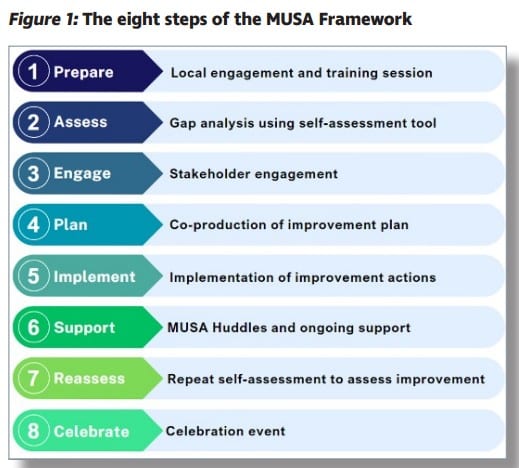
The MUSA Framework operationalises the use of the Standards through an eight-step improvement cycle, supporting quality improvement and emphasising co-production and stakeholder engagement (see Figure 1).
The main aims of MUSA are to:
- Benchmark practice against evidence-based standards.
- Facilitate a self-assessment of practice to identify gaps and areas of good practice.
- Co-produce improvement plans with staff, women and stakeholders.
- Embed continuous learning through communities of practice.
- Standardise approaches to operational risk assessment in Mus.
- Support sustainable processes of continuous improvement.
A crucial part of implementing MUSA involves a benchmarking self-assessment against the Standards with the aim of identifying good practice and areas for improvement and producing a gap analysis. Unlike external audits and reviews, MUSA is led by the MU-specific stakeholders, with the goal of empowering MUs to lead their own improvement.
Implementing MUSA involves collaboration between local project leads and external facilitators, who provide ‘fresh eyes’. Having and valuing a new perspective has been recognised as a part of positive safety culture.6 As external facilitators, we typically work with MUs for a year, first understanding their local context and goals before developing a project timeline. We also provide troubleshooting sessions during the self-assessment and a gap analysis of improvement areas and collaborate to develop a community of practice between MUs. Improvement plans are co-created with the MUs and consider areas of good practice, which are shared and celebrated to ensure learning from what works well.
Developing MUSA
MUSA was created as a collaboration between City St George’s, University of London, Midwifery Unit Network and expert stakeholders. From 2019 to 2021, we conducted two pilot case studies with ten MUs in the UK and Europe to evaluate the self-assessment tool in practice, identify barriers and facilitators for implementation within maternity services and inform the development of the framework for the subsequent MUSA programme.5 MUSA’s development included working with an advisory group of midwives, service users, policymakers and academics, who reviewed and steered its content.
Practice Challenge 2
How can we link our improvement work to broader quality improvement frameworks?
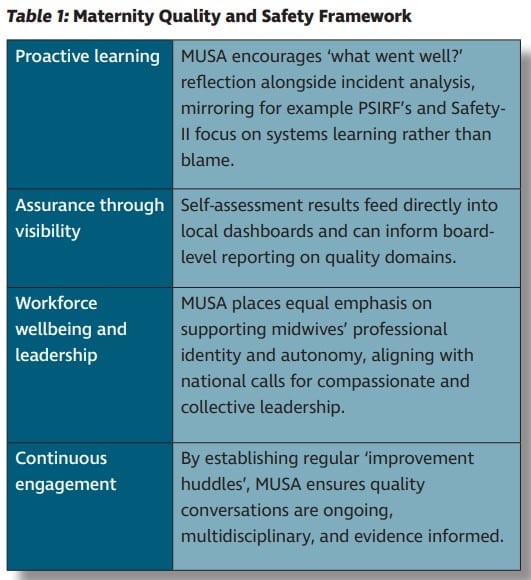
MUSA is underpinned by principles of co-production, particularly fostering ownership, openness and shared decision-making, and reflects fundamental principles of maternity care safety. Within the UK’s evolving safety landscape, MUSA can act as a complementary tool to local Maternity Quality and Safety Frameworks supporting compliance with regulatory governance and assurance (see Table 1). MUSA supports assurance through structured self-evaluation, evidence dashboards and improvement huddles. It brings a shared language to quality discussions – linking local experiences to national standards and policy goals for equitable, person-centred care. The outcome is a joined-up, transparent model where improvement, assurance and workforce wellbeing intersect.
More broadly, MUSA builds on anthropological research into how MUs function as complex adaptive systems, where trust, relationships and environment shape positive experiences, teamworking and organisational culture.7,8 It also aligns with a Safety-II perspective, which prioritises learning from what goes right and takes a strengths-based approach when considering improvement.9 MUSA recognises that MUs and wider maternity services are complex and variable, requiring flexibility and adaptability. This is why the self-assessment tool functions as a guide for improvement that can be tailored to local contexts rather than a prescriptive document.
Case study: MUSA Wales
Wales provides a unique context for maternity improvement. With a population of three million and average of 26,000 births per year, spread across rural and urban regions, maternity services are delivered through seven health boards offering both alongside and freestanding MUs. Welsh Government policy has long promoted equitable, community-based care.10,11 A report from the maternity and neonatal safety support programme’s recommended that Welsh MUs should benchmark against the Midwifery Unit Standards to identify variation and risks and to inform quality improvement activity.12 This was also recommended in the all-Wales midwifery-led care guidelines, which aim to ensure a standardised approach to midwifery care nationally.13
Practice Challenge 3
How can we link our improvement work to national policy?
MUSA Wales was supported by the Wales Maternity and Neonatal Strategic Clinical Network and led by consultant midwives (Consultant Midwives Cymru). MUSA was implemented as a national improvement programme across all seven Health Boards, with the aims of standardising self-assessment, reducing duplication, creating a shared culture of learning across birth settings and strengthening quality, safety and person-centred care in MUs. Specific objectives included: enabling every Health Board to complete a self-assessment against the Standards; conducting a national gap analysis to identify common priorities; co-designing improvement actions at macro-(policy), meso- (organisational) and micro-(front-line) levels; and building a sustainable community of practice led by consultant midwives.
Welsh model of implementation MUSA
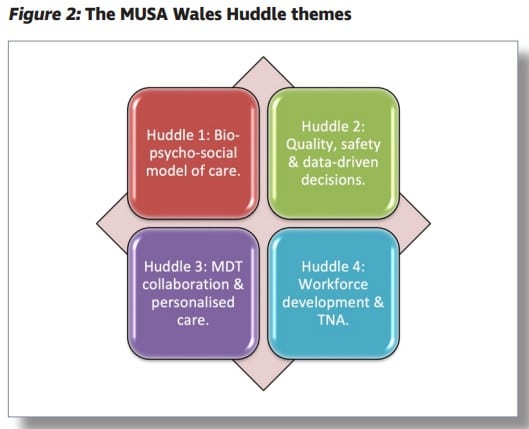
Wales followed a structured 12-month roadmap, beginning in December 2024. A national launch set strategic priorities, followed by 20 MUs completing self-assessment with ad-hoc support. The gap analysis identified four key improvement themes: public philosophy of care, governance alignment, multidisciplinary collaboration and data-driven quality improvement.
Four improvement Huddles (community of practice workshops supporting shared learning) were held from April to September 2025. The Huddle themes reflected the findings from the national gap analysis and were co-produced by the MUSA team and Consultant Midwives Cymru (see Figure 2). Huddles are supplemented with a mid-point review, covering learning from Health Boards, sharing quick wins and identifying systemic barriers.
The MUSA team provided tools and templates, including an advisory group setup guide, training needs analysis template and marketing strategy ‘how-to’ guide. These resources standardised improvement methods across Wales, embedding evidence-based practice within local autonomy. The team also undertook an evaluation of MUSA Wales to assess the implementation of MUSA nationally. We conducted real-time data collection and focus groups to inform an evaluation report and ensure MUSA Wales was well-reported. The project was completed in December 2025 with a celebration event, during which MUs reflected, discussed positives changes and shared future improvement plans.
Progress and lessons learned
All Health Boards completed the initial MUSA cycle with the 12-month timeline, with clear evidence of engagement and ownership. Key achievements included:
- Strong national collaboration: Consultant midwives and local leads worked across organisational boundaries, creating a unified improvement community.
- Enhanced professional leadership: Consultant Midwives Cymru Group used MUSA to champion visibility and influence within governance structures.
- Integration with national priorities: Actions aligned with the Welsh Government Quality Statement for Maternity and Neonatal Care and the All-Wales Perinatal Engagement Framework.11,14
- Workforce empowerment: Midwives reported renewed confidence in advocating for physiological birth, promoting choice, and shaping improvement locally.
- Resources and learning: Huddles generated articles, evidence packs and case examples, supporting reflective discussion and local adaptation.
Feedback indicates that MUSA Wales contributed to strengthened leadership capability, improved consistency of care and increased engagement from service users. Importantly, it re-energised professional identity at a time of significant workforce pressure. The Huddles acted as learning spaces where participants presented updates, exchanged solutions and reflected on cultural and organisational change. They connected staff establishing a community of practice and enabled them to realise that challenges are similar and solutions can be shared. Community of practice sessions are planned beyond the 12-month MUSA project to support further improvement and maintain an all-Wales approach within MUs.
Practice Challenge 4
How do we address the barriers to providing and then improving midwife-led care?
Implementation across a whole nation inevitably surfaced challenges. Time pressures, workforce shortages and digital infrastructure gaps, yet the collective ownership model proved resilient. The following learning points have emerged:
- National coordination adds value: Shared timeline and common framework prevented duplication and helped smaller units access expertise.
- Leadership at every level is essential: Consultant midwives provided strategic drive, but success depended equally on frontline champions.
- Continuous communication sustains momentum: Huddles, newsletters and shared folders ensured all participants felt part of the same journey.
- Flexibility within structure: While the framework is standardised, each health board was able to tailor local actions to context.
Implementing MUSA on a wider scale highlighted the importance of embedding evaluation from the start. This is in line with increasingly recognised features of robust large-scale improvement initiatives, which includes commitment to sound, transparent evaluation.15
Discussion
The MUSA Framework exemplifies how quality improvement and safety assurance converge. Conventional assurance models often focus on retrospective review, whereas MUSA supports proactive reflection and ownership, offering a strengthens-based approach to improvement. One key feature of MUSA is standardisation without centralisation, in which common principles are embedded with local flexibility. Given the policy prioritisation of community-based care,16,17 quality improvement efforts should aim to function in a localized, rather than centralised, way. This is indicative of whole-system perspective, which views the system as multi-level and complex, requiring flexible and contextualised visions for change.
We argue that flexible, adaptable quality improvement programmes promote enhanced accountability. MUSA’s self-assessment process necessitates openness and honesty to function successfully. Specific actions, such as improving dashboards and creating advisory groups, enable transparency and shared oversight. Improvement programmes that value and respect staff and stakeholders as assets and resources are vital for fostering ownership and workforce sustainability. During MUSA Wales, we found that valuing midwives’ expertise was connected to their morale, with many sharing that they felt undervalued by the wider maternity service.
Practice Challenge 5
How do we undertake quality improvement that is more positive and sustainable?
In the UK, there is an imperative to address the deep-rooted cultural challenges within maternity care. National reviews have identified the need for stronger learning culture, respectful teamwork and compassionate leadership as essential foundations for safe, high-quality maternity services.18 Positive safety culture – defined by openness, shared learning and psychological safety – is intrinsically linked to collaborative, inclusive and compassionate leadership.19 Such leadership fosters trust, enables constructive challenge and supports staff to speak up and learn from error rather than fear and blame. MUSA incorporates these principles through creating and supporting opportunities for reflection, shared ownership, and open dialogue across multidisciplinary teams. By encouraging teams to co-produce improvement plans and celebrate strengths alongside identifying gaps, MUSA promotes accountability and continuous learning in action. This approach exemplifies the cultural-safety shift required and aligns with a compassionate leadership model,20 reinforcing the view that improvement in maternity outcomes is inseparable from improvement in culture. From a policy perspective, MUSA strengthens the ‘learning health system’ model advocated by national strategies in the UK. It demonstrates that high-quality care cannot rely solely on compliance; it must grow from reflective, empowered teams.
Conclusion
The MUSA Wales project illustrates what is possible when professional leadership, national collaboration and evidence-based improvement align. Through MUSA, midwives across Wales have re-defined how quality is discussed and delivered. They have shown that improvement is most powerful when driven from the frontline, supported by structured reflection and compassionate leadership. As maternity services continue to evolve, MUSA offers a replicable model for embedding continuous improvement and strengthening the voice of midwifery. MUSA reminds us that quality is not an audit – it is how we care, learn and lead every day. TPM
References
- Birthplace in England Collaborative Group. Perinatal and maternal outcomes by planned place of birth for healthy women with low-risk pregnancies: the Birthplace in England national prospective cohort study. BMJ. 2011;343:d7400. doi.org/10.1136/bmj.d7400.
- Scarf VL, Rossiter C, Vedam S, et al. Maternal and perinatal outcomes by planned place of birth among women with low-risk pregnancies in high-income countries: a systematic review and meta-analysis. Midwifery. 2018;62:240-255. doi.org/10.1016/j.midw.2018.03.024.
- Batinelli L, Thaels E, Leister N, McCourt C, Bonciani M, Rocca-Ihenacho L. What are the strategies for implementing primary care models in maternity? A systematic review on midwifery units. BMC Pregnancy Childbirth. 2022;22(1):123. doi.org/10.1186/s12884-022-04410-x.
- Rocca-Ihenacho L, Batinelli L, Thaels E, Rayment J, Newburn M, McCourt C. Midwifery Unit Standards. City, University of Londonhttps:// www.midwiferyunitnetwork.org/wp-content/uploads/PDFs/LY1309BROMUNEt-Standards-PRINT-opt.pdf. Published 2018.
- Yuill C, Kerauden S, Murphy R, Uddin, N, Rocca-Ihenacho L. Developing the Midwifery Unit Self-Assessment (MUSA) Framework: a mixed-methods study in six European midwifery units. Sex Reprod Healthc. 2023;100819. doi.org/10.1016/j.srhc.2023.100819.
- Safety culture: learning from best practice. NHS England. https:// www.england.nhs.uk/long-read/safety-culture-learning-from-bestpractice/. Updated November 15, 2022. Accessed November 03, 2025.
- McCourt C, Rayment J, Rance S, Sandall J. An ethnographic organisational study of alongside midwifery units: a follow-on study from the Birthplace in England programme. Health Social Care Dev. 2014;2(7). doi.org/10.3310/hsdr02070.
- Rocca-Ihenacho L, Yuill C, McCourt C. Relationships and trust: Two key pillars of a well-functioning freestanding midwifery unit. Birth. 2021;48(1):104-113. doi.org/10.1111/birt.12521.
- Hollnagel E, Wears RL, Braithwaite J. From Safety-I to Safety-II: A White Paper. University of Southern Denmark, University of Florida, Macquarie University, Australia; 2015. doi.org/10.13140/RG.2.1.4051.5282.
- Maternity Care in Wales: A Five-Year Vision for the Future (2019– 2024). Welsh Government. https://www.gov.wales/sites/default/files/ publications/2019-06/maternity-care-in-wales-a-five-year-vision-for-thefuture-2019-2024.pdf. Published July, 2019.
- The All-Wales Perinatal Engagement Framework Report. Welsh Government. https://www.gov.wales/sites/default/files/ publications/2025-02/perinatal-engagement-framework-report.pdf. Published 2025.
- Improving Together for Wales: Maternity Neonatal Safety Support Programme Cymru Discovery Phase Report. Public Health Wales. . phw.nhs.wales/services-and-teams/improvement-cymru/our-work1/ matneossp/report/. Published July, 2023.
- All Wales Midwifery-Led Care Guidelines 6th Edition. Wales Maternity and Neonatal Network. wisdom.nhs.wales/all-wales-guidelines/allwales-guidelines/all-wales-midwifery-led-care-guideline-2022/. Published 2022.
- Quality Statement for Maternity and Neonatal Services. Welsh Government. https://www.gov.wales/sites/default/files/pdfversions/2025/5/3/1747814705/quality-statement-maternity-andneonatal-services.pdf. Updated February 11, 2025.
- McGowan J, Attal B, Kuhn I, et al. Quality and reporting of largescale improvement programmes: a review of maternity initiatives in the English NHS, 2010–2023. BMJ Quality & Safety. 2024;33:704-715. doi. org/10.1136/bmjqs-2023-016606.
- Fit for the future: 10 Year Health Plan for England: Department of Health and Social Care. https://assets.publishing.service.gov.uk/ media/6888a0b1a11f859994409147/fit-for-the-future-10-year-health-planfor-england.pdf. Published July, 2025. Accessed November 03, 2025.
- The Women’s Health Plan for Wales: A 10-year vision 2025-2035. NHS Wales. https://meassociation.org.uk/wp-content/uploads/2024/12/ NHS-Wales-Womens-Health-Plan-2025-35-Dec.24-1.pdf Published December, 2024
- Kirkup B. Reading the signals. Maternity and neonatal services in East Kent – the Report of the Independent Investigation (HC 681). Crown. https://assets.publishing.service.gov.uk/government/uploads/ system/uploads/attachment_data/file/1111992/reading-the-signalsmaternity-and-neonatal-services-in-east-kent_the-report-of-theindependent-investigation_print-ready.pdf. Published October, 2022.
- The NHS Patient Safety Strategy: Safer culture, safer systems, safer patients. NHS England. https://www.england.nhs.uk/wp-content/ uploads/2020/08/190708_Patient_Safety_Strategy_for_website_v4.pdf. Published July, 2019.
- West M, Eckert R, Collins B, Chowla R. Caring to Change: How compassionate leadership can stimulate innovation in health care. The King’s Fund. https://assets.kingsfund.org.uk/f/256914/x/0b76247d02/ caring_to_change_2017.pdf. Published May, 2017.