









Abnormal Uterine Bleeding: Finding Solutions For Heavy Menstrual Flow
Dr Anna Byrom – Founding Director, CEO, All4Maternity
Social @acbmidwife
Published in The Practising Midwife Volume 28 Issue 2 March 2025, Page 23
https://doi.org/10.55975/DMHJ3273
Introduction
Heavy menstrual bleeding has a significant impact on the quality of life for those women and people experiencing it, including increased risk of iron deficiency anaemia. Personalised care from midwives and health professionals is crucial to determine the causes, impact and treatment to improve outcomes and experiences. In this Topic Highlight, heavy menstrual bleeding is considered alongside the importance of identifying and treating associated iron deficiency anaemia as an under-recognised and under-reported symptom of abnormal uterine bleeding.
Definitions and symptoms
Abnormal uterine bleeding (AUB) is the preferred term used to describe ‘any bleeding from the uterus that is abnormal in flow, volume, regularity, frequency or duration’.1 Heavy menstrual bleeding (HMB) is defined by MacGregor, et al.,1 as ‘bleeding that is sufficient to interfere with quality of life’ and they recommend avoiding ambiguous terms such as menorrhagia that can be confusing and lead to misunderstanding, see Table 1. Previous definitions of HMB have focused on volume of blood loss greater than 80mls per menstrual cycle. However, the MacGregor, et al.,1 definition aligns with National Institute for Health and Care Excellence (NICE) guidelines that recommend HMB definitions must also include blood loss that is self-defined as excessive, even if the quantity is below 80ml.2

Table 1: Preferred current terminology focused on heavy and prolonged menstrual bleeding (adapted from MacGregor et al1)
| Preferred terminology | Interpretation | Redundant terminology (do not use) |
| Abnormal uterine bleeding | Bleeding that is abnormal in amount (duration
And volume) and/or timing |
Dysfunctional uterine bleeding |
| Heavy menstrual bleeding | Bleeding that is sufficient to interfere with quality of life | Menorrhagia, uterine haemorrhage |
| Prolonged menstruation | Menstruation that lasts more than 8 days | Hypermenorrhea |
| Frequent menstruation | Occurring more regularly than every 24 days | Epimenorrhea, polymenorrhea |
AUB, including HMB, can be chronic (present for more than six months) or acute (an episode requiring immediate action to prevent further blood loss). HMB is often experienced with symptoms such as passage of large blood clots, flooding (soaking through clothes while wearing menstrual products) and/or regular changes of sanitary products and symptoms of anaemia.1
Prevalence and impact
HMB has high prevalence around the world. In the United Kingdom it accounts for approximately 20 per cent of all referrals to gynaecology services. Many instances of HMB go unreported or unreferred due to social normalisation, health inequities and discrimination.3
HMB frequently leads to iron deficiency anaemia (IDA) due to chronic, monthly blood loss. IDA symptoms include fatigue, dizziness, shortness of breath and pallor.1 Those with a history of HMB preconception are more likely to develop low iron when nutrient requirements increase further during pregnancy. In addition, people with HMB can experience emotional impacts particularly as it interrupts daily activities and quality of life.3
Understanding the cause
The aetiology of HMB can be useful categorised using the PALM-COEIN classification system which was introduced by the International Federation of Gynaecology and Obstetrics (FIGO)4 see Table 2. PALM acronym includes: Polyps, Adenomyosis, Leimyomas and Malignancy. COEIN acronym includes Coagulopathy, Ovulatory and Endometrial dysfunction and Iatrogenic causes.
Table 2: FIGO classification system for abnormal uterine bleeding adapted from Munro et al4
| Structural causes (PALM) | Non-Structural causes (COEIN) | ||
| P | Polyps | C | Coagulopathy e.g. von Willebrand disease |
| A | Adenomyosis (endometrial tissue in uterine muscle layer) | O | Ovulatory dysfunction e.g. Polycystic Ovary Syndrome |
| L | Leiomyomas (Fibroids) | E | Endometrial dysfunction
|
| M | Malignancy and hyperplasia | I | Iatrogenic e.g. use of anticoagulants or IUD complications |
| Other contributory factors include obesity, which increases oestrogen levels, and chronic inflammatory conditions, which can exacerbate endometrial instability. | N | Not yet classified | |
Care considerations
As recommended by NICE guidance, it is crucial that health professionals first recognise how HMB has a major impact on quality of life, ensuring that any approach to treatment and care aims to improve this beyond a focus on amount of blood loss.2 This is enabled through careful history taking, identifying the signs and symptoms as experienced by the woman or person accessing care. This includes identifying systemic symptoms, critically those that could indicate IDA.1 IDA symptoms include: shortness of breath, chest pain and fatigue. Global rates of IDA are at 30% for those people who menstruate, making it the most frequent micronutrient deficiency affecting up to 60% of women with HMB. Yet, IDA continues to be under-recognised, under-reported and under-treated.1
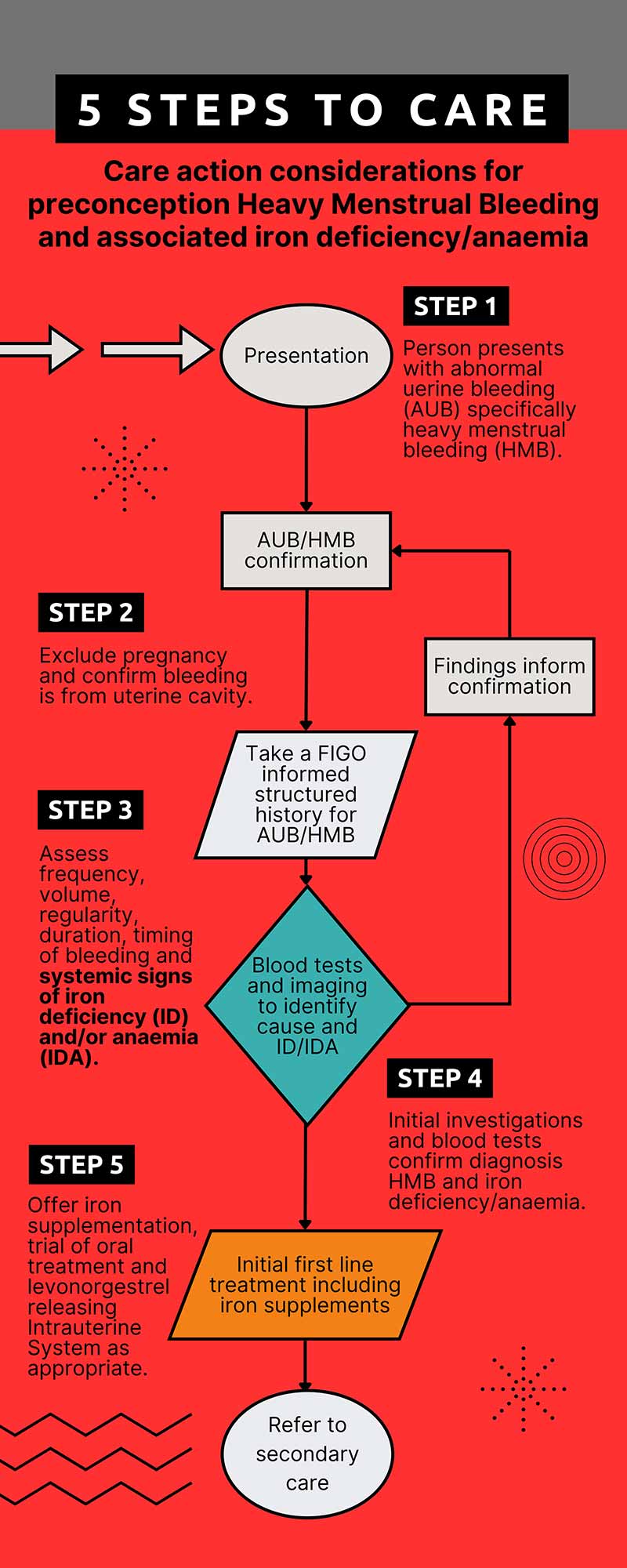
See the infographic flow chart below that captures the five-step primary care actions focused on identification of HMB and IDA with appropriate recommended next- step actions including identification of iron deficiency and anaemia and early treatment with iron supplementation.
Conclusion
HMB impacts significantly on quality of life for women and people who experience it. It is a significant contributor to the high prevalence of IDA around the world. Midwives and maternity professionals are in a unique position to raise awareness, demystify and promote access to care ensuring timely referral and holistic support before, during and beyond the childbearing continuum for those experiencing HMB. TPM
Other Resources
To read an insightful fact sheet on this topic here
Take a FREE course “Iron Deficiency in Pregnancy an Introduction” here
References
- MacGregor R, Jain V, Hillman S, Lumsden MA. Investigating abnormal uterine bleeding in reproductive-aged women. BMJ. 2022;378:e070906. doi.org/10.1136/ bmj-2022-070906.
- Heavy menstrual bleeding: assessment and management. NICE guideline (NG88). https://www.nice.org.uk/guidance/ng88. Updated May 24, 2021. Accessed January 28, 2025.
- National Heavy Menstrual Bleeding Audit: Final Report. RCOG. https://www. hqip.org.uk/wp-content/uploads/2018/02/HwNYNM.pdf. Published July, 2014. Accessed January 28, 2025.
- Munro MG, Critchley HO, Broder MS, Fraser IS, FIGO Working Group on Menstrual Disorders. FIGO classification system (PALM-COEIN) for causes of abnormal uterine bleeding in nongravid women of reproductive age. Int J Gynaecol Obstet. 2011;113(1):3-13. doi.org/10.1016/j.ijgo.2010.11.011.

