








Essential Skills for Facilitating Group Care
Octavia Wiseman (she/her) – Specialist Midwife, King’s College Hospital, London; Research Fellow, Centre for Maternal and Child Health Research, City, University of London
Social @OctaviaWiseman
Jalana Lazar (she/her) – Midwife researcher, Adjunct Faculty, Georgetown University, USA and Consultant, Group Care Global, USA
Jedidia Abanga – Programmes Coordinator, Inclusive Child Development Programme, Presbyterian Church of Ghana Health Service, Accra, Ghana
Margie Rickell – Consultant, Group Care Global, USA
Carrie Klima (she/her) – Clinical Professor Emerita, College of Nursing, University of Illinois Chicago, USA
Published in The Practising Midwife Volume 27 Issue 4 July 2024, Pages 36-39
https://doi.org/10.55975/KHJC8022
Summary
Facilitating group care successfully necessitates learning a range of essential skills including managing group dynamics, active listening, facilitating participant-led discussions and interactive activities. Developing these skills requires training, practice, confidence and a good dose of humility. Unlearning the role of midwife as expert is necessary to flatten hierarchy and draw out the expertise of the women/birthing people in order to enhance participants’ learning. This can feel challenging and anti-intuitive for midwives trained and practising in didactic systems. In this article we explore how developing the inter-personal skills required for group care facilitation can enhance the role of the midwife.

Background
Centering®-based group antenatal care (gANC) encompasses all the core competencies enshrined in midwifery education and practice internationally, such as providing competent clinical care, support and advocacy. However, transitioning to a group care model requires specific skills less familiar to midwives and other practitioners who may facilitate gANC (health visitors, general practitioners, etc). Facilitative leadership in a group environment brings to the foreground skills such as active listening, a tolerance for silence and uncertainty, trust, managing your own and others’ emotions, understanding group dynamics and community building.
While some midwives learn to facilitate groups by working alongside experienced facilitators, the majority undertake facilitation training consisting of one or two-day practical workshops. Training is designed to be interactive, just like gANC sessions themselves. Midwives learn through storytelling, activities, role-play, small-group work and problem-solving. Reflection about the learning process is in-built so that students become aware of how these interactive teaching methods impact on their own learning, promoting an embodied understanding of the power of experiential learning.
Changing from traditional care
The decision by maternity services to change to gANC arises from a desire to improve service delivery, health outcomes and practitioner and participant satisfaction. The gANC model differs significantly from individual care by reimagining antenatal care, putting women, birthing people and their families at the centre of care and reconfiguring the role and responsibilities of the midwife. The model itself is described in detail in the article in this issue authored by Rising, et al,. New skills which facilitators need to develop include teaching participants to take responsibility for collecting their own health data (e.g. measuring blood pressure), learning to carry out brief one-to- one maternal and neonatal health checks within the group space, and managing group dynamics, for example, addressing participants’ concerns and covering educational topics through facilitated discussions and activities. Midwives must learn to draw out the participants’ own expertise, whether from lived experience or formal knowledge, to enable the peer learning which deepens their understanding and builds confidence. This transformation from didactic teaching to a facilitative role requires the midwife to engage in power-sharing relationships, creating a different care experience which can be transformative not just for participants but for the midwives themselves. Empowered group members can better care for themselves and their family during and after pregnancy. Participant-led discussions enable midwives to learn about the challenges participants face. Building trust increases disclosure, enabling more appropriate personalised care planning.
Facilitation is an art
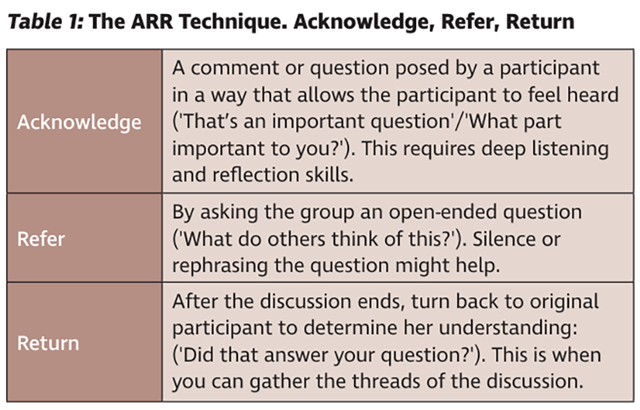
Active listening is the most important skill midwives need to cultivate to facilitate gANC, requiring curiosity, trust, maintaining silence, asking open-ended questions, reflecting, reframing and pulling together threads. These elements contribute to participants learning to trust each other, the midwife and the health care system. While the list may seem daunting, these skills are developed during training using tools such as Acknowledge, Refer, Return (ARR) to structure facilitative discussions (see Table 1). These skills grow as midwives practice and get more comfortable with the dance of facilitation.
Dealing with difficult news in the group is also a learned skill, one that becomes easier with confidence and experience.
Midwives must learn to trust that the group will know what is best from them. Vulnerability and humility are important attitudes for establishing a non-hierarchical space. Midwives may initially find this uncomfortable due to their own disempowered position in the healthcare hierarchy. This is something learned from experience and practise.
Community building
One aim of gANC is community building, promoting participants’ wellbeing beyond the boundaries of maternity services. Midwives are trained to put a range of tools in place to support this.
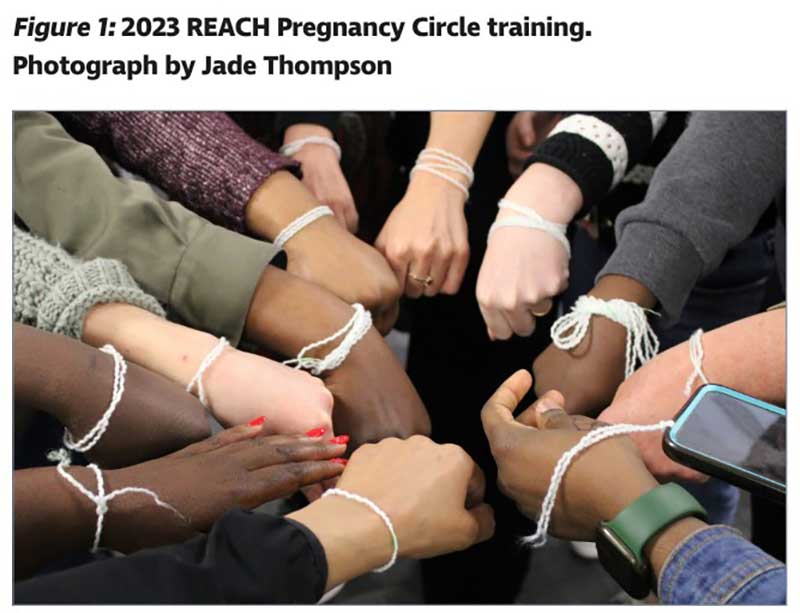
Continuity of facilitators and participants facilitates trusting relationships. Group composition may differ in terms of age, language, culture and risk profile, so building group rapport can be challenging. Midwives should appreciate the diverse experiences each member contributes, skilfully managing shy or over-eager participants to create a safe space where everyone feels included.
“Dealing with difficult news in the group is also a learned skill, one that becomes easier with confidence and experience. Midwives must learn to trust that the group will know what is best from them. Vulnerability and humility are important attitudes for establishing a non-hierarchical space.”
Incorporating culturally-appropriate interactive activities (e.g. sharing songs or healthy foods) can serve as a powerful bonding tool. Opening activities can set the tone for relaxed sharing, promoting group cohesion and closing activities (‘what are you taking away with you today?’) can consolidate shared learning.
Midwives use tools such as a ‘talking stick’ (or ‘talking tit’ as UK midwives call it, where a knitted breast is thrown back and forth) and anonymous questions to ensure that everyone has an equal opportunity to take part. A skilled facilitator learns to manage conflicts and summarise differing opinions respectfully. Overall, the success of gANC relies on the facilitator’s ability to create a comfortable and engaging environment that encourages participation and fosters a sense of community. These social bonds are strengthened when participants are encouraged to form their own social media groups.
Evaluation
Evaluating your groups allows critical opportunities for self- reflexivity, improvement, sharing successes and planning. In keeping with the participatory nature of group care, asking questions such as, ‘what went well today?’ is an effective evaluation method. On a macro level, auditing maternal and neonatal outcomes for participants can be important for decision-makers and funders.
Ongoing learning
Although formal training is important to become a gANC facilitator, the real learning starts with practice, in particular building your confidence when working with groups, which many midwives are nervous about. This way of working brings its own challenges and it is essential to access ongoing support. Local, national and international communities of practice enable trouble-shooting, peer learning and consolidation of group facilitation skills. In the Netherlands and Belgium, attending additional training/group reflection sessions within two years of initial training is a requirement for certification; in North America a formal site sign-off process is required. In other countries, reflection sessions or mentorship arrangements with experienced practitioners are available. Negotiating protected time to attend these enhances facilitators’ practice. Services who wish to extend the model into the postnatal period (gPNC) can easily adapt this training approach for different professionals and contexts. The gANC model offers the unique opportunity to work alongside and learn from another professional. Time for reflection and planning after each session is needed to embed learning and improve skills: How facilitative were we? What went well? What could we do better? In some services informal mentorship arrangements spring up, or facilitators form WhatsApp groups. Train-the-trainer programmes support sustainability and scale-up of the model, embedding trainers within maternity services.
Conclusion
The wide range of facilitation skills needed to deliver gANC require specialist training, reflection and ongoing peer support. While this may feel onerous for busy midwives, feedback suggests that group care training and practice is a fun and liberating experience. As midwives become confident facilitators and learn to trust the group, many say they feel like real midwives again. TPM
Centering-based group care resources
Please find below a list of resources for more information, group care training and support:
Training
- International: https://groupcare.global
- UK: Advancing Midwifery Practice – Facilitating Group Antenatal Care. Professional development course. City, University of London www.city.ac.uk or contact oc*************@*****ac.uk
- The Netherlands: https://centeringzorg.nl
- United States: www.centeringhealthcare.org
- Belgium: https://groupcarebelgium.be
- Suriname (Perisur): www.perisur.org
- Ghana, Kosovo and South Africa all have locally available trainers. Please contact through Group Care Global or the Community of Practice (see below).
Group facilitation
- Rising SS, Quimby CH. The Centering Pregnancy Model: The Power of Group Health Care. New York NY, Springer Publishing Co; 2016. ISBN 082613243X, 9780826132437.
- Pollack S. Moving Beyond Icebreakers. Boston, Center for Teen Empowerment; 2005. ISBN: 9780976665809, 0976665808
- Preparation for Birth and Beyond. DOH. https://assets.publishing.service.gov.uk/media/5a7cce7a40f0b65b3de0b47f/dh_134728. pdf. Published June 29, 2012.
- Jans S, Rijnders M, Hilhorst D. Little pearls: short group care stories with a large impact. https://groupcare.global/wp-content/ uploads/2022/12/Littlepearls-interactief.pdf. Published 2020. ISBN 978-94-6402-021-2.
Community of Practice
- International: IBP Network (WHO) international Community of Practice: https://groups.ibpnetwork.org/g/groupcare. For free membership please email: groupcare+su*******@***************rk.org
- UK: Facebook group UK Maternity Group Care Facilitators Community of Practice. https://www.facebook.com/groups/2214702442045611.
Research and implementation
- International: GC_1000 website – https://www.groupcare1000.com
- International: Group Care Global – https://groupcare.global/
- International: Group Care Collaborative – https://www.ganccollaborative.com/mission-2
- TNO department of Child Health – https://www.tno.nl/en/about-tno/tno-society/innovation-development/child-health/
- UK: REACH Pregnancy Circles – https://blogs.city.ac.uk/reach/the-pregnancy-circles-trial
- UK: Postnatal group care (Leeds) – https://myfirst1000days.co.uk
- USA: Centering Healthcare Institute – www.centeringhealthcare.org/why-centering/research-and-resources
Social media sites
All the organisations, such as Group care Global, GC_1000, CenteringZorg, REACH and the UK maternity Group Care Facilitators Community of Practice are active on Facebook, Instagram, X and LinkedIn.

