








The Group Antenatal and Postnatal Model: A Description
Sharon Schindler Rising (she/her) – Founder, CenteringPregnancy®, Board member of Group Care Global, USA
Social linkedin.com/in/sharon-schindler-rising-31269716/
Katja van Groesen (she/her) – Director of the Dutch Foundation CenteringZorg, Member of the Advisory council of Group Care Global, The Netherlands
Social linkedin.com/in/katjavangroesen/
Published in The Practising Midwife Volume 27 Issue 4 July 2024, Pages 14-17
https://doi.org/10.55975/LRPX8448
Summary
Centering-based group care brings together a cohort of eight to 12 pregnant people with similar gestation early in pregnancy for care during eight to ten sessions throughout pregnancy and early postpartum. The group sessions may continue until the second year postpartum for care for both the birthing parent and the baby. Successfully putting the group care model into practice is based on group facilitation rather than didactic, class-like presentations. Basic antenatal clinical care is provided individually during the group sessions, making it reimbursable within the setting’s payor system.
Introduction
The original group care model, CenteringPregnancy®, was first defined in the literature in 1998 and CenteringParenting a few years later. As international interest in the model grew, the need for flexibility to respond to varying cultural and health systems led to a change in the model name to Centering-based group antenatal and postnatal care (gAPNC). With this umbrella title the model fits for both antenatal and postpartum/parenting group care. However, names may vary by country, for example in the UK this is known as Pregnancy and Parenting Circles, in Suriname as SamenZwanger en SamenOuder and in Belgium as Mama to be(e). Essential in all these models is the approach of group sessions including health assessment, interactive learning and peer support/community building, and replacing individual healthcare. Perhaps you have heard about group care and wondered if this was a term for group classes or if it really is a model that includes the actual antenatal/ postpartum and well-baby care. If it does include care, it may be hard to imagine how better care could happen in a group rather than in an individual visit. The Centering-based antenatal group care model (gANC) is relationship-based care that builds on the wisdom of each person in the group and honors the deep cultural values held and practiced by participants. The group is a dynamic environment that enriches all members.
A snapshot
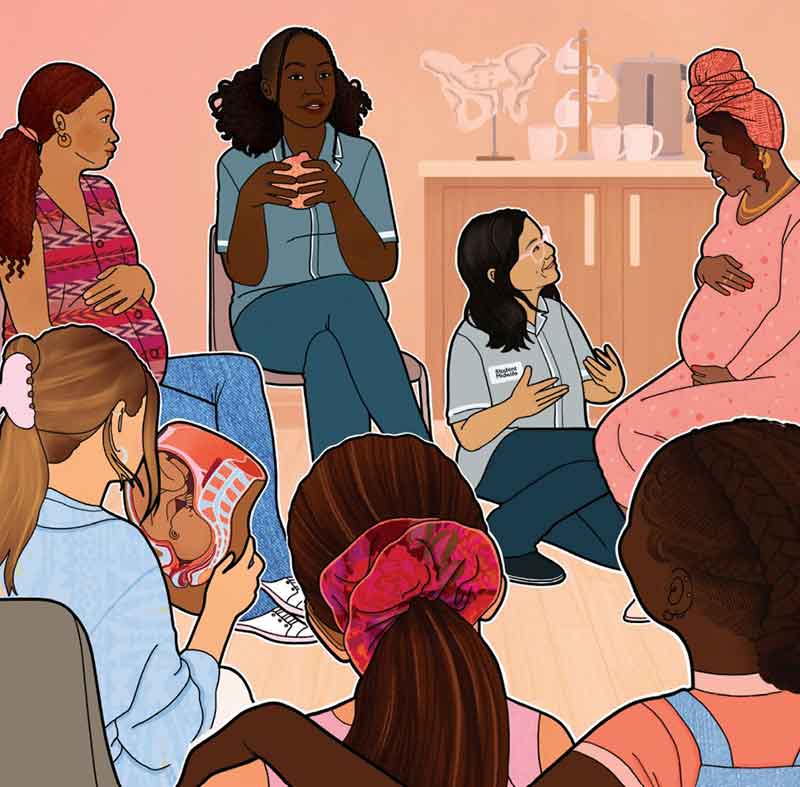
A snapshot of gANC would show you a group of eight to ten pregnant people of similar gestation gathering at the same time in a welcoming private group space. There is a table to sign in, make a name tag and perhaps enjoy water and a small snack. Music is playing in the background. Your colleague begins a bit of orientation including how to do a self-take blood pressure, assess weight and record these data in a written or electronic format. One by one, each person is invited to join you in a private space within the room for a brief health and physical assessment of the mother/baby dyad.
Once you have completed these individual assessments everyone gathers in an open circle to begin an interactive, facilitated discussion that includes questions that have been raised by the participants during their individual assessment. You and your co-facilitator have planned activities to spring content discussion based on the available group care manual that helps you to discuss important information interactively and design activities, but your focus is on the issues brought by the participants.
During this interactive learning time of approximately 60 to 90 minutes, you have shared information, listened to each person’s contributions, enjoyed a few interactive activities and had a closing circle. You realise that so much varied information is shared, enriching your understanding of solutions and challenges you may not have considered. Everyone benefits. Since the cohort is stable, threads of content can surface in subsequent sessions allowing for enriched discussion. Before participants leave, each person will be clear about the schedule for the next session and about any follow-up needed. They may even have exchanged contact information.
Model description
Centering-based group care is composed of three components and several definers to maximise success in achieving these components.1 The components are: health assessment (medical/health care provided by protocol and similar to individual visits), interactive learning (facilitated discussion of content; not didactic) and community-building (peer support and community outreach).
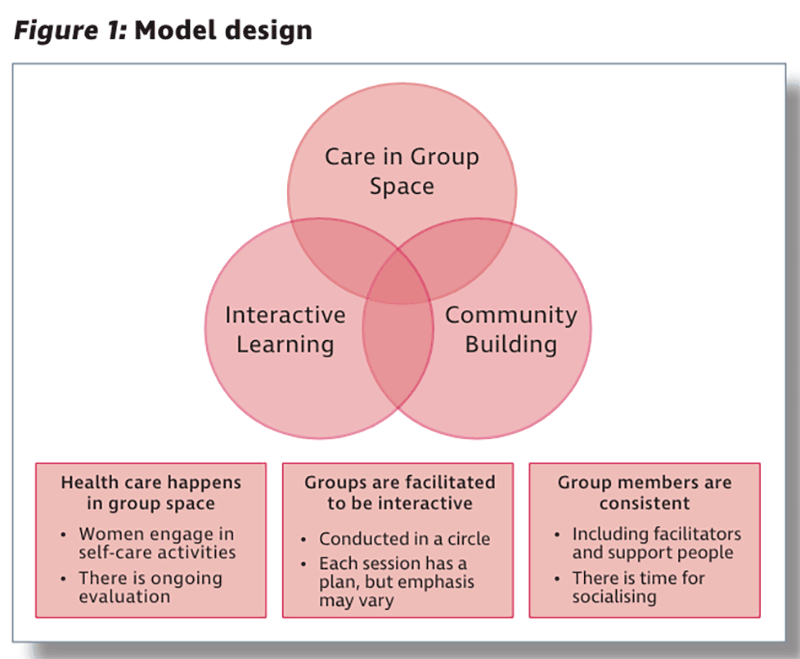
Here is a closer look at each of the core components and some of the important definers:
Health assessment
Provision of usual antenatal/postpartum care. The pregnant person collects self-data including blood pressure and weight and records that data. The midwife does a short assessment of the woman and fetus including appropriate growth of the baby and overview of the woman’s adjustment and special needs. Group facilitators maintain records of attendance and any other important data that can be used to evaluate process and outcomes.
Interactive learning
Being in group is a time for participants to talk about issues of concern to them. A stable cohort throughout eight sessions allows for the building of trust and support to share concerns and questions. The midwife and another facilitator can gently guide the discussion but are careful not to dominate or answer questions. It is important for the group members to share and surface solutions. The development of keen listening skills will help to assure the discussion is dynamic and not didactic. You may use interactive activities to enrich this learning time.
‘Someone would bring up a topic which would trigger another person to discuss a related idea. And sometimes someone would bring up an issue that I was too embarrassed to talk about.’
Community-building
The model assumes a stable cohort of people who go through pregnancy and the postpartum period together. The group facilitators connect with the group and provide continuity throughout this childbearing period. Members often exchange contact information and begin to reach out in helpful ways. The model is designed for eight to ten antenatal sessions and over the course of the sessions you will see increasing trust develop among the members.2
“Centering-based group care is composed of three components and several definers to maximise success in achieving these components.1 The components are: health assessment (medical/health care provided by protocol and similar to individual visits), interactive learning (facilitated discussion of content; not didactic) and community-building (peer support and community outreach).”
Trust in each other, trust in you and the health system, trust in their own ability to make changes and to become a parent all contribute to strengthening of empowerment and self-confidence.
‘I had a group of people in my corner. I was with real people who shared pieces of themselves with me for almost an entire year.’
At the end of the session, you often will say, ‘we’ve just had so much fun!’. You will reflect on the content of the discussion and realise that it was much richer than anything you could have done over and over again in individual visits. And you may say, ‘why wouldn’t I provide care this way?’. The data of over 200 studies states that health outcomes and satisfaction with care are better than that of individual care.3
‘… but honestly in my groups, I can remember all of the women’s names and you can’t really say that for when you are in an antenatal clinic and all the women come in and out, you don’t remember them.’ (gANC midwife)
Some logistics
Each of the participants has had an individual intake that includes a physical and psychosocial assessment, lab work and other testing per protocol of the setting. This data is available ahead of the session so you have some understanding of the needs of each participant. The first group session most commonly happens between 12 to 16 weeks gestation, with subsequent sessions scheduled to follow the usual design for antenatal care in your setting. You see each person individually in a private corner within the group space for a three-minute assessment that focuses on the growth of the baby and the medical parameters of the visit. During that time, you are in conversation with the woman. Inevitably, questions arise and one woman’s question is another woman’s question. With their permission, issues and questions raised are brought to the group. Discussion in the group allows everyone to benefit and often surfaces culturally-based strategies and beliefs that guide behaviour.
The group sessions are scheduled for two hours with approximately 30 to 40 minutes for check-in, individual health assessment, time for socialising and 60 to 70 minutes for facilitated discussion, and another ten minutes for a short break and closing. Groups start and end on time so all participants can manage work schedules or childcare or transportation needs with confidence. This also supports the larger schedule of the midwife, which would usually be filled with individual care visits.
Once the groups are established, participants often want to continue meeting for postpartum/well-baby care.4 These first two postpartum years present many challenges for new parents. For women/parents there are reproductive health choices, support for mental health issues, breastfeeding support and parenting issues. This is a crucial time for assessing the baby’s health and development as well as assuring immunisations are given on time. This time, from the beginning of pregnancy through to the first two years postpartum is referred to as The First 1000 Days with Centering-based group care continuing the groups through this entire period. Although most settings provide group antenatal care only, postpartum/well-baby care is increasingly offered.
‘Your babies are the only ones my baby knows. We have to celebrate with a first birthday party.’
Yes, it takes work to change the system to support group care. Gather together the people who can work with you to create change and include a client or two who can join the redesign effort. This is meaningful change that leads to increased satisfaction with care for all the participants. Midwives often say, ‘it’s the one thing in my day that brings me joy!’ TPM
Reflective questions
- How might participating in group antenatal care differ from traditional one-on-one care, both in terms of experience and outcomes?
- Reflecting on the interactive learning component described, how do you envisage the group dynamic fostering the exchange of different perspectives among participants?
- Considering the concept of community-building within the model, how do stable groups throughout pregnancy and the postpartum period contribute to empowerment and self-confidence among participants?
- In what ways does the group care model address the holistic needs of pregnant individuals and new parents, beyond just medical care? And how might this contribute to overall wellbeing?
“The group sessions are scheduled for two hours with approximately 30 to 40 minutes for check-in, individual health assessment, time for socialising and 60 to 70 minutes for facilitated discussion, and another ten minutes for a short break and closing. Groups start and end on time so all participants can manage work schedules or childcare or transportation needs with confidence. This also supports the larger schedule of the midwife, which would usually be filled with individual care visits.”
Further learning and resources
Learn more about Group Care by completing one of our specially curated courses, ‘Essential skills for facilitating Group Care during the first 1000 days’. Reflect on your learning by accessing the All4Maternity HUB here.
References
- Rising SS. Centering Pregnancy: An Interdisciplinary Model of Empowerment. J Nurse Midwifery. 1998:43(1):46-54. doi. org/10.1016/s0091-2182(97)00117-1.
- Kweekel L, Gerrits T, Rijnders M, Brown P. The role of trust in CenteringPregnancy: building interpersonal trust relationships in group-based prenatal care in the Netherlands. Birth. 2016;44(1):41-47. doi.org/10.1111/birt.12260.
- Sadiku F, Bucinca H, Talrich F, et al. Maternal satisfaction with group care: a systematic review. AJOG Glob Rep. 2023;4(1):100301. doi.org/10.1016/j.xagr.2023.100301.
- Bloomfield J, Rising SS. CenteringParenting: an innovative dyad model for group mother-infant care. J Midwifery Womens Health. 2013;58(6);683-89. doi.org/10.1111/jmwh.12132.

