









‘I’m very stressed…’
Published in The Practising Midwife Journal Volume 22 Issue 2 February 2020 Page 19
Sheena Byrom OBE – Consultant Midwife and Director All4Maternity
I am contacted regularly by student midwives and midwives who tell me they are desperate, ‘burnt -out’ and sad that they can’t give the midwifery care they want to. It’s a story frequently told; as a clinical midwife, I said the same words myself several times to my managers. I also recounted these anguished messages to the head of finance when working as a senior midwifery manager and advocating for the retention of midwives. If we want to provide meaningful, secure maternity care and to feel able to work as a midwife, then we need strategies. The first is to care for ourselves. We are human beings, with a basic hierarchy of needs that if unmet will potentially render us helpless and ineffective and potentially sick. ‘Self-care’ has become to some an unwelcome buzz word, often used in the same sentence as ‘resilience’ which is another cause of contention. Yet, both concepts are absolutely crucial in sustaining our practice – they represent an area of well-being, and what can be more important than that?

Enhance your wellbeing
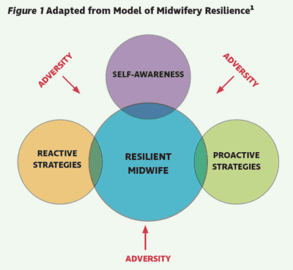
Recent debates on social media have highlighted frustration that issues of short-staffing and organisational demands are conflated with low levels of individual midwives’ resilience. This is unacceptable, and a complete misuse of the meaning of resilience- the ability to mentally or emotionally cope with a crisis or to return to pre-crisis status quickly. It is not a method of managing chronic long-term stressors. So maybe we need to put the record straight, and I ask you to join me in that quest. Promoting mental wellbeing does require us to build resilience in any situation personal or professional, to be prepared for situations, to know how to deal with them and to reflect and recover. It means we need to be self-aware, to learn what our triggers are, and to look after ourselves at all times. In their research Hunter and Warren1 found that midwives who were able to ‘bounce-back’ after adverse situations had developed ways to cope through reactive strategies (accessing social support, positive mood changers such as music and exercise, reflection, attempting to keep a work-life balance), developing self-awareness (knowing yourself, realistic expectations, love or midwifery practice, strong professional identity) and using proactive strategies to develop personal resilience and resilience in others (supporting and empowering colleagues, self-awareness of triggers, self-protection). The authors created a useful Model of Midwifery Resilience to help as a guide, found in Figure 1.
My message to you
Keep those you serve at the centre of all your actions. Speak up for your rights to have enough time and resources to provide the care you want to give. If you have a difficult shift, talk it over with a trusted colleague or friend and get support. Offer the same to them. Notice how you feel when under pressure and manage your expectations. Acknowledge what really makes you feel happy and take time out to indulge yourself. Check out your colleagues, are they coping? Offer them support and encouragement; it could be a life-changer for you both. Don’t fit in with negative cultures. Remember the passion and desire you talked about at your interview to become a midwife – the words that got you chosen.
Keep them close to your heart. TPM
References
- Hunter B, Warren L. Caring for ourselves: the key to resilience In (Eds) Byrom S, Downe S. The Roar Behind the Silence: why kindness, compassion and respect matter in maternity care. London: Pinter and Martin; 2015: 111-116.