









The moment is here…now
Studysheet aim and key information:
As human beings, our interactions with each other encompasses physical, mental, spiritual and emotional connections that varies depending on the nature of that interaction. In midwifery, much of our work is on the emotional level, whether is managing our own emotions in clinical situations or through supporting women, people and their partners through their own changing emotions. However, this ‘emotion work’ is an undervalued and often hidden aspect of our work, with much more attention given to the physical acts of ‘doing’ clinical tasks. This study sheet uses a Maternity Voices reflection from The Practising Midwife to shine a light on the value of positive ‘emotion work’ that makes an extraordinary difference for women’s experiences of care and their transition to motherhood.
 Learning objectives:
- To consider the role and importance of attuning to an individual woman.
- To consider and recognise the importance of meaningful ways to connect emotionally to women.
- To learn that women take their cues from their midwives, therefore their emotional responses will be guided by our invitation.
- To recognise emotion work as a positive component of meaningful midwifery care.
Duration: 30 mins
Keywords: Emotion work, connections, midwifery care


The moment is here… now
Kate Greenstock – Student midwife, Kingston University, St George’s, University of London
Published in The Practising Midwife Volume 23 Issue 3 March 2020
Just another day in THE community?
 A woman attends a postnatal appointment in a community health centre with her four-week-old baby. Her experience of breastfeeding has been challenging. As the midwife asks how she is doing, she becomes teary. The community midwife turns completely from her written notes and focuses fully on the woman, with strong eye contact. After a pause, she validates the woman’s underlying emotions, verbally acknowledging the way she has persevered and reached out for help. With conviction, and a tone of voice ‘speaking from the heart’, her posture and eyes remaining focused on the mother, she celebrates the learning, useful for the road ahead. In other words, she does not just validate the outcome (successful breastfeeding) but the rich and difficult learning process and its benefits for the ongoing journey of breastfeeding and mothering.
The woman appears visibly moved by the midwife’s acknowledgement of her vulnerability and determination. The atmosphere shifts as the midwife slows from her regular appointment pace to use silence; to witness and speak to the woman before her; to metaphorically hold the woman, as she holds her baby.
As humans under pressure, we still have a choice in each moment
In the encounter I have described, a number of things could have happened. The midwife could have skipped over the woman’s emotions with the next question/piece of information within the discharge ‘protocol’. Or met them with over-vigorous blanket reassurance (you’re doing brilliantly…); helpful to a point, but not person specific, nor naming the true challenge and achievement. Tissues offered in kindness could have been, perhaps unknowingly, a way to stem the tears, the feelings or the discomfort of the listener, rather than take the extra minute to allow those feelings to unfold. I saw none of this.
The moment is here…now
Edwards1 explores how women take their cues from midwives. If we ‘keep our emotional lids on’, so will they.1 (p40) What is lost, then, when we as midwives detach from women and even from ourselves, putting up boundaries, including creating stereotypes of women, in order to protect ourselves from the reality that we probably can’t meet fully their needs?2 Edwards suggests that this more ‘formulaic’ care leads to an increased passivity in women – that anxieties grow rather than trust, and that a woman’s stance is shaped over time into ‘hoping for the best’, rather than sharing real fears or emotions, limiting her sense of agency and ability to make the decisions she wants.1
Holistic care means celebrating the mother and normalising sadness
Part of the holistic care I witnessed was the birthing person being celebrated – a stance lacking in our society as the spotlight moves to the wellbeing and needs of baby. There exist very few rituals in the UK marking the transition to motherhood and very few people acknowledge the amount of emotion work required. This includes the letting go of former identity involved in what Winson4 calls the grief work of becoming a mother: ‘a major reconstruction of the self without being prepared, supported or recognised by society’.3 (p146)
As midwives we do have a role in preparing a woman for this reconstruction, supporting her through it, and recognising her in it. It should not surprise us that sadness can be a normal part of women’s experience postnatally. The midwife in this encounter normalised rather than medicalised the mother’s sadness/grief, thereby likely validating a whole range of complex, largely unspoken feelings.
Continuity of care makes a difference
This postnatal encounter was not an isolated incident. The mother had met this midwife before and had been cared for by a small community team with good communication and handover, meaning it was easier for the midwife to connect with the woman’s wider story. Both the Cochrane Review into continuity of care models4 and the National Maternity Review5 highlight increased satisfaction rates for women experiencing continuity of carer and philosophy. Dykes6 goes further and calls for a restoration of older rhythms and relationships between midwife and mother in this vulnerable time, in order for midwives and birthing parents to engage in and benefit from the emotion work that is at the heart of the transition to motherhood.
How can this inspire our practice as midwives?
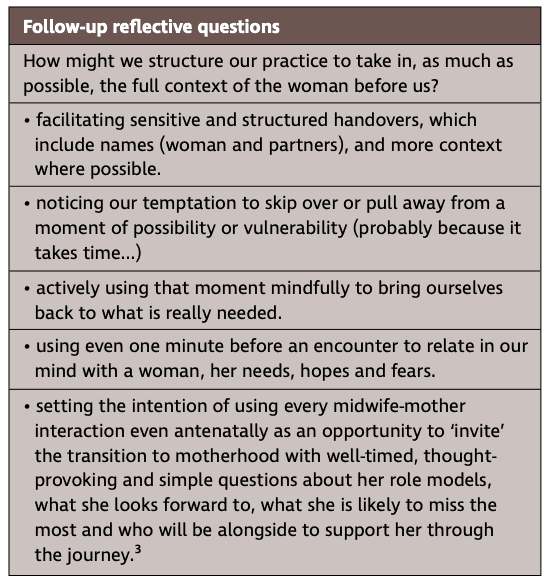
It can undoubtedly be overwhelming and disempowering working within the structures of NHS maternity care. Going on recognising the potential in every conversation, with every new woman or family, could be an antidote to feelings of overwhelm. Personally, I plan to go on exploring with myself and colleagues the concept of emotion work: what it looks like, and means to us as midwives to experience dissonance between the woman-centred care we want to offer and the institutional, systemic realities in a hospital setting. My ongoing reflection will be: how do I stay connected and present, rather than distancing myself from the women and even from myself as a way of managing those feelings of dissonance.7
Will you join me? TPM
References
- Edwards, N. Women’s Emotion Work in the context of current maternity services: In Hunter B, Deery R, eds. Emotions in Midwifery and Reproduction. Basingstoke: Palgrave Macmillan; 2009:36-55.
- Deery R, Hunter B. Emotion Work and Relationships in Midwifery: Enhancing or Challenging?: In Kirkham M, ed. The Midwife–Mother Relationship. 2nd ed. Basingstoke: Macmillan Press; 2010:37-54.
- Winson, N. Transition to Motherhood: In Squire C, ed. The Social Context of Birth 3rd ed. Oxon: CRC Press; 2017:141-155.
- Sandall J, Soltani H, Gates S, Shennan A, Devane D. Midwife-led continuity models versus other models of care for childbearing women. Cochrane Database of Systematic Reviews. 2016;4:1-96.
- Better Births. Improving outcomes of maternity services in England. A Five Year Forward View for maternity care. National Maternity Review 2016. https://www.england.nhs.uk/publication/better-births-improving-outcomes-of-maternity-services-in-england-a-five-year-forward-view-for-maternity-care/. Published February 2016. Accessed May 20, 2018.
- Dykes F. ‘No time to care’: Midwifery work on postnatal wards in England: In Hunter B, Deery R, eds. Emotions in Midwifery and Reproduction. Basingstoke: Palgrave Macmillan; 2009:90-104.
- Hunter, B. ‘Mixed Messages’: Midwives’ experiences of managing emotion: In Hunter B, Deery R, eds. Emotions in Midwifery and Reproduction. Basingstoke: Palgrave Macmillan; 2009:175-191.
FURTHER READING, VIDEOS AND LINKS
All4Maternity E-module Non-verbal communication skills for enhancing midwifery practice
TPM Feature Article Why caring counts
To develop further self-understanding, important in emotion work we recommend books from Brené Brown

The download button below enables you to be able to print off and complete the study sheet, alternatively you might want to annotate the PDF and save to your computer, ready for adding to your student portfolio or for midwifery revalidation
-
Extend your learning by looking through the further reading, videos and links above
- Reflect on a time someone made you feel really cared for, listened to, and validated. Maybe you opened up to them about something that was bothering you. Write down what that person did and how they did it which signalled their emotional connection to you. What aspect of this interaction made a difference for you?
- Now consider how you convey your emotional connection to others, how do you make them feel comfortable, cared for and validated? Make a list of key words.
- Reflect on what challenges you face when delivering care to providing the emotional space to women. How could this mitigated? What key things could you do centre and ground yourself during busy, stressful shifts? Make a list of key things, and consider printing them out to keep with you as a reminder.
- Write a manifesto for your philosophy of care, what would you want women, people and partners to know about your approach to care?
- Find a picture online that sums how you feel about your philosophy of care, it can be as abstract as you like! You might see an image on the all4maternity website that resonates with you.
