









Communication skills study sheet
Study sheet aim and key information:
This study sheet uses The Practising Midwife Journal’s Advancing Practice Series ‘Communication Skills’ article to help you to explore your knowledge around communication in practice. Excellent communication is the cornerstone of safe, effective and compassionate care, both between client and provider and between multidisciplinary practitioners. Whether you are a student beginning a new placement, a midwife returning to practice or an independent practitioner brushing up on handover – this study sheet will help to refresh your knowledge.
 Learning objectives:
- Having knowledge and understanding of varied communication strategies for practice
- Appraise barriers and facilitators to communication within your scope of practice
- Recognise and apply methods of open-ended questioning with clients
- Identify the role of the midwife/birth worker in providing structured team communication
Duration: 30 mins
Keywords: Communication, rapport, listening, empathy


Communication Skills; Life After Attending And Participating In NHS Connected Course In Advanced Communication Skills; A Midwife’s Perspective
Mary Edmondson – Midwife at Luton and Dunstable University Hospital
Published in The Practising Midwife Volume 11 Issue 10 November 2017
Communication is a process of giving and receiving messages and is essential to providing competent care (England and Morgan 2012; Silverman et al 2016). The poor quality of communication identified in reports (Knight et al 2014; 2016), has been highlighted as a cause of mistakes in maternity care for some time (NHS England 2016a; Kirkup 2015; Titcombe 2015; Leonard et al 2004).
A midwife has to communicate in so many ways, in hospital and community settings, emergency situations and with all of the multi-disciplinary team. The aim of this article is to identify and discuss some communication skills and their application in two practice situations. I share my learning following attendance at an advanced communication skills course and related further masters-level study. Suggested practice challenges are incorporated in this article to assist with a focused learning approach.
The skills learnt in these settings are transferable to any encounters and conversations midwives may have with women, partners and families
Background
I have been a midwife for many years, and have attended assertiveness courses, multi–disciplinary training, challenging conversations, and human factors training. However, it is only recently that I have been exposed to training with a detailed ‘skills-based approach’. The NHS connected communication skills course (NHS England 2017; NHS 2016b) provided theory and practical sessions to facilitate a deeper understanding of communication skills and how to improve them. The course was run in a collaborative, supportive and participatory environment to maximise learning. The evidence supporting skills-based communication training originates from the cancer care setting (Maguire 1999; Fallowfield et al 2002).
The course I attended was within a hospice education setting, and attendees were mostly working in hospices or in palliative care, including the facilitators. It became apparent that the hospice nurses on the course shared a philosophy of patient-focused care, and it appeared that it was never too much trouble for them to provide time for their patients. The impact of this course has also been reviewed by a nurse (Bramhall 2014), whose enthusiasm is also evident.
Practice Challenge 1
Be aware that colleagues may have difficulties with communication. Identify communication skills training in your locality.
Links to midwifery
I was initially wondering how the training would link with midwifery practice. Having run a randomised controlled trial, Fallowfield et al (2002) assert that the communication skills learnt are applicable across different settings and are long lasting. The course covered: barriers to communication; communication skills; and application of communication skills.
The communication skills learnt are applicable across different settings and are long lasting
Identifying and improving communication skills in practice
As midwives we have to improve our communication skills in practical terms, when working in teams, and in one-to-one interviews and consultations (Silverman et al 2016). The NHS connected course skills-based approached is centred on the work of the earlier researchers encompassed in Silverman et al (2016).
Listening skills
I have often found it difficult as a midwife to understand my own judgements and feelings, which presents a barrier to effective listening and affects perception (England and Morgan 2012). The experiences discussed within the scenarios presented in England and Morgan are centred on day-to-day practice in a delivery-suite environment, and the skills learnt in these settings are transferable to any encounters and conversations midwives may have with women, partners and families (England and Morgan 2012; Fallowfield et al 2002).
Practice challenge 2
Obtain copies of ‘Skills for communicating with patients’ (Silverman et al 2016) and ‘Communication skills for midwives’ (England and Morgan 2012).
This can result in increased disclosure of information that really matters and might otherwise be missed
Kirkham’s (1989) seminal and groundbreaking work explored information-giving and communication in delivery-suite settings. A feature of the work was a focus on the midwife picking up cues.
I have found that picking up cues and asking open questions do link to concerns that need addressing (Silverman et al 2016). Asking open questions, such ‘How are you feeling?’ that have a psychological stance rather than a specific question aimed at drawing a fact-based reply demonstrates that the clinician is interested in them as a person (Maguire et al 1996). This can result in increased disclosure of information that really matters and might otherwise be missed (Maguire et al 1996). Open questions linked to a cue are 4.5 times more likely be associated with further disclosure Fletcher (2006, cited by NHS 2016b).
Supporting reports and professional documents
 Facilitating choice and personalised care, and improving maternal and fetal outcomes has been placed as a priority by the government’s Maternity transformation (NHS England 2017), Saving babies’ lives (NHS England 2016a) and Better births (NHS 2016b).
- Kate Grainger launched a campaign (Grainger 2015) to encourage health workers to acknowledge their patients in a dignified manner by saying, ‘Hello my name is…’. This opening to any communication will instantly establish a rapport with the woman and her family (Silverman et al 2016).
- The Nursing and Midwifery Council (NMC) Code for nurses and midwives (NMC 2015), updated as a result of the findings of the Francis report (Francis 2013) and Kirkup (2015), states: You put the interests of people using or needing nursing or midwifery services first.
You make their care and safety your main concern and make sure that their dignity is preserved and their needs are recognised, assessed and responded to. You make sure that those receiving care are treated with respect, that their rights are upheld (NMC 2015: 4).
PRACTICE CHALLENGE 3
Review the NMC Code (NMC 2018). Begin reflecting on your own communication skills. Read the latest report summaries.
Application of skills learnt in practice
In order to demonstrate the significance of communication skills, here are two scenarios where communication was key to the outcome. The first scenario is based on a conversation with a father, and the second involved escalating a cardiotocograph concern.
Listening to a father
An element of the course was to write about a conversation I facilitated, so I chose one I had facilitated with a father. Women’s partners tend to be keen to observe what is going on (practice) and want care to be carried out safely (Redshaw and Henderson 2013; Titcombe 2015).
The importance of the father and their experience as a birth partner is profiled by fathers (Harris 2016; Titcombe 2015), researchers (Redshaw and Henderson 2013) and midwives (England and Morgan 2012).
The frame of reference for undertaking the conversation described was based on the Calgary Cambridge Guide of which elements are:
- Gathering information
- Building and developing a rapport
- Using appropriate non–verbal behaviours (Silverman et al 2016: 19).
Core communication skills, to be used throughout the conversation, were identified as:
- Empathy
- Non-judgemental
- Honesty
- Self awareness (Silverman et al 2016).
Listening skills used (Silverman et al 2016):
Establishing a rapport:
- Greeting: saying ‘Hello, how are you?’
- Introductions: purpose of conversation; job role; role in this situation
Gathering information:
- Minimal prompts show the participant that you are listening. Prompts used included: mmm, ah, ah ha, great, oh, I see, hmmm and nodding
- Maintaining eye contact: if eye contact is not achieved, this can make the speaker think the listener is not interested
- Clarifying: checking understanding of what is being said
- Paraphrasing: repeating what is said
Non–verbal communication:
- Positive body language: leaning forward, arms apart
- Maintaining eye contact
Developing a rapport:
- Enabling the father to express himself
- Acceptance of the father’s feelings and views
Forward planning:
I needed to consider any actions as a result of the conversation. I tried to practise skills of communication, which are listed in Figure 1 below:
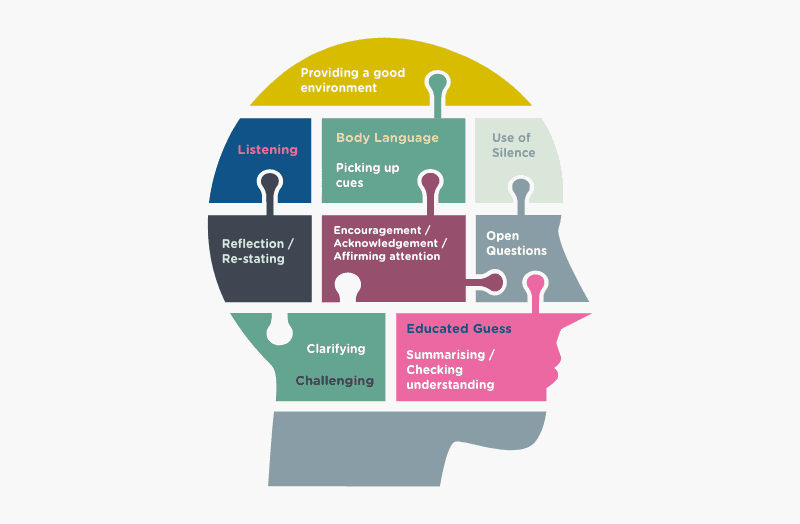
Figure 1: Skills of communication
PRACTICE CHALLENGE 4
Think back to a conversation you have had and identify whether there were any blocking behaviours (Silverman et al 2016) you could have avoided, such as:
- changing the subject
- not making eye-contact
- not hearing
- not letting someone finish their sentence
- interrupting
- not maintaining positive non-verbal communication.
Notice in your daily practice how listening and picking up on issues and concerns of women and their partners can transform the women’s and partners’ experience and also enhance your job satisfaction. Involve the partner in discussions about care, if the woman wishes (Harris 2015).
Role-play of a clinical situation
Course participants had to reflect on a difficult or pertinent situation that they wished to review and role-play with an actor. The role-play was videoed by the course leader.
Escalating a cardiotocograph concern
The actor was briefed outside the study room, and the briefing included the job roles of those involved in the scenario, their personality and the situation. I briefed the actor about a particular clinical communication aspect that I wanted to practise, which was related to escalating a cardiotocograph concern. Then we returned to the course room and commenced the role-play. The filming was stopped after one minute, to identify how much ground could be covered in a short space of time and to enable course members to comment on my performance at that time.
On completion of the role-play, I watched the replay of the video with other course members. On watching, I realised how little I verbalised information, even though I recalled that, in the role-play, my concern for the cardiotocograph was foremost in my mind.
To externalise internalised concern, the use of structured communication such as the ‘SBAR’ mnemonic and persuading the other person to see your personal concern, are recommended by Leonard et al (2004). Situation, Background Assessment and Recommendation (SBAR) is used frequently in hospitals, but I propose that the essentials of communication skills must be uppermost, such as: eye contact; clear statements of concern; checking that the message has been received; and securing commitment.
PRACTICE CHALLENGE 5
Practise discussing your practice issues and concerns with friends and colleagues. Visualise yourself gaining help in any emergency situation, and consider what language you would use. Identify possible barriers to emergency communication in your area.
Conclusions
I have profiled a few elements of clinical communication skills that midwives can think about and practise. Listening and gathering information from women and their partners is vital to their safety, and to achieving the highest level of care that is understood by all.
Recognising areas of improvement through self-awareness and reflection is paramount to maintaining and improving the skills of communication. I hope that NHS trusts will consider providing this course for midwives and nurses. TPM
REFERENCES
Bramhall E (2014). ‘Effective communication skills in nursing practice’. Nursing Standard, 29(14): 53-59.
England C and Morgan R (2012). Communication skills for midwives. Challenges in everyday practice, Milton Keynes: Open University Press.
Fallowfield L, Jenkins V, Farewell V et al (2002). ‘Efficacy of a Cancer Research UK communication skills training model for oncologists: a randomised controlled trial’. The Lancet, 359.
Fletcher I (2006). Patterns of verbal interaction between health professionals and cancer patients. Unpublished PhD thesis, Manchester: University of Manchester.
Francis R (2013). Report of the Mid Staffordshire NHS Foundation Trust Public Inquiry, London: Crown. www.gov.uk/government/uploads/system/uploads/attachment_data/file/279124/0947.pdf
Grainger K (2015). Dr Kate Grainger – Hello my name is. www.hellomynameis.org.uk/
Harris M (2015). Men, love and birth, London: Pinter and Martin Ltd.
Kirkham M (1989). ‘Midwives and information giving during labour’. In: Robinson S and Thomson A (eds). Midwives, Research and Childbirth, Boston MA: Springer.
Kirkup B (2015). The report of the Morecambe Bay investigation, London: The Stationery Office.
Knight M, Kenyon S, Brocklehurst P et al (2014). Saving lives, improving mothers’ care lessons learned to inform future maternity care from the UK and Ireland confidential enquiries into maternal deaths and morbidity 2009-2012, Oxford: University of Oxford.
Knight M, Nair M, Tuffnell D et al (2016). Surveillance of maternal deaths in the UK 2012-14 and care lessons learned to inform maternity care from the UK and Ireland confidential enquiries into maternal deaths and morbidity 2009-2014, Oxford: University of Oxford.
Leonard M, Graham S and Bonacum D (2004). ‘The human factor: the critical importance of effective teamwork and communication in providing safe care’. Quality and Safety Health Care, 13(Suppl 1): i85-i90. www.ncbi.nlm.nih.gov/pmc/articles/PMC1765783/pdf/v013p00i85.pdf
Maguire P (1999). ‘Improving communication with cancer patients’. European Journal of Cancer, 35(10): 1415-1422.
Maguire P, Faulkner A, Booth K et al (1996). ‘Helping cancer patients disclose their concerns’. European Journal of Cancer, 32A(1): 78-81.
Maguire P and Pitceathly C (2002). ‘Key communication skills and how to acquire them’. British Medical Journal, 325(7366): 697-700.
NHS England (2016a). Saving babies’ lives. A care bundle for reducing stillbirth, Leeds: NHS England. www.england.nhs.uk/wp-content/uploads/2016/03/savingbabies-lives-car-bundl.pdf
NHS England (2016b). National maternity review. Better births, improving the outcomes of maternity services in England, a five year forward view for maternity care, London: NHS England.
NHS England (2017). Maternity transformation programme, London: NHS. www.england.nhs.uk/mattransformation
NMC (2018). The Code. Professional standards of practice and behaviour for nurses and midwives, London: NMC. http://www.nmc.org.uk/standards/code/
Redshaw M and Henderson J (2013). ‘Fathers’ engagement in pregnancy and childbirth: evidence from a national survey’. BMC Pregnancy and Childbirth, 13: 70. https://bmcpregnancychildbirth.biomedcentral.com/articles/10.1186/1471-2393-13-70
Silverman J, Kurtz S and Draper J (2016). Skills for communicating with patients, London: Taylor and Francis Group.
Titcombe J (2015). Joshua’s story. Uncovering the Morecambe Bay NHS scandal, Leeds: Anderson Wallace Publishing.
FURTHER READING, VIDEOS AND LINKS
American Family Physician – Patient-Centered Communication: Basic Skills
The King’s Fund: Communication
WHO – Recommendation on effective communication between maternity care providers and women in labour
NICE Evidence Search – Clinical Handover in Maternity Services
NHS Improvement – Implementing handovers and huddles: a framework for practice in maternity units
Better Births – Improving outcomes of maternity services in England
All4Maternity – Non-verbal communication skills for enhancing midwifery practice

The download button below enables you to be able to print off and complete the study sheet, alternatively you might want to annotate the PDF and save to your computer, ready for adding to your student portfolio or for midwifery revalidation
-
Extend your learning by looking through the further reading, videos and links above and completing the practise challenges within the article
- List 10 strategies for effective communication.
- Bullet point or paraphrase the key learning from this article.
- Practice open-ended communication skills. Think of a scenario and identify a series of open-ended questions you could use to elicit information and demonstrate rapport building. Tip: Read the American Family Physician article for ideas.
- Use the SBAR tool below to practice practitioner-practitioner handover of care. Blank SBAR can be found using the downloaded PDF button below.

- Reflect on your practice. Pick a recent scenario relating to communication with a client, what happened? What were the barriers? What was the impact and what could have been improved?
